
How product configurators combine visualization, interaction, and customization to help manufacturers communicate complex products and improve customer decision-making.
Published on 9. Jul 2026

Kert Klementi
CEO & Founder | Business Visualization Strategist

Introduction
Today, the challenge for manufacturers is no longer simply creating great products—it is helping customers understand them. Across industries, products are becoming increasingly customizable. Materials, finishes, dimensions, modules, technical specifications, and optional features provide customers with greater flexibility than ever before. At the same time, these possibilities create complexity. Customers are often asked to make decisions about products they cannot physically see, touch, or compare side by side.
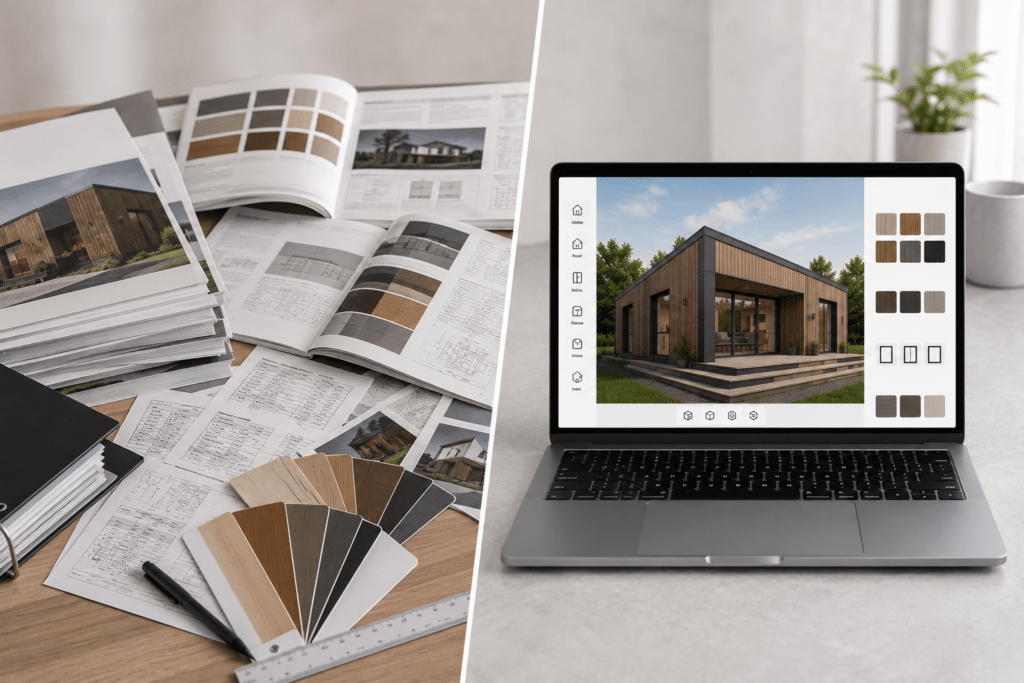
Traditional product catalogues, technical datasheets, and static product photography still play an important role, but they are often insufficient when products can be configured in hundreds or even thousands of different ways.
This is one reason why product configurators have become increasingly important. Modern product configurators & product visualizers combine visualization, customization, and user interaction into a single experience. Rather than reading about available options, customers can actively explore them. Instead of imagining the final result, they can see it.
Companies such as IKEA have popularized this approach through planning tools, room planners, and product configurators that allow customers to experiment with layouts, combinations, and product variants before making a purchase decision. Similar principles are now being adopted by manufacturers of furniture, building products, modular buildings, industrial equipment, and technical products worldwide.
At Nordic Render, we view product configurators as more than software solutions. They are communication tools. Their purpose is to transform complex product information into an experience that customers can understand, evaluate, and trust.
The Growing Complexity of Product Selection
Modern manufacturing has evolved significantly over the past two decades. Customers increasingly expect products to fit their specific needs rather than adapting their needs to standard products. Whether selecting facade materials, configuring a modular building, choosing furniture finishes, or specifying industrial equipment, buyers are presented with a growing number of options.
For manufacturers, this creates both opportunities and challenges. On one hand, customization allows businesses to offer more value and differentiate themselves from competitors. On the other hand, every additional option introduces complexity into the customer journey. A customer selecting a dining table may need to choose between multiple dimensions, materials, edge profiles, finishes, and leg designs. A construction professional evaluating facade systems may need to compare colors, textures, fixing methods, and installation options. Industrial buyers often face even more complicated configuration processes involving technical specifications and compatibility requirements.
As the number of available options grows, so does the amount of information customers must process before making a decision. What begins as an opportunity for personalization can quickly become overwhelming, particularly when products are technically complex or highly configurable. Customers may struggle to understand how individual choices influence the final product, making it more difficult to compare alternatives and move confidently toward a purchasing decision.
The consequences extend beyond the customer experience. Sales teams often spend considerable time answering similar questions, clarifying product options, and helping buyers navigate available configurations. Misunderstandings become more likely, and projects can take longer to progress from initial interest to final specification. The issue is rarely a lack of information. In most cases, manufacturers provide extensive documentation, technical data, and product details. The challenge lies in transforming that information into something customers can quickly understand and confidently act upon.
This is precisely where product configurators and interactive planning tools create value. By combining product information with visualization and real-time interaction, they help customers explore options, understand the impact of their choices, and arrive at decisions with greater confidence.
What Is a Product Configurator?
A product configurator is an interactive digital tool that allows users to customize products and instantly visualize the results of their choices.
Depending on the product, users may be able to:
- Select materials and finishes
- Change colors and textures
- Adjust dimensions
- Add optional features
- Compare product variants
- Configure modular systems
- Build personalized product combinations
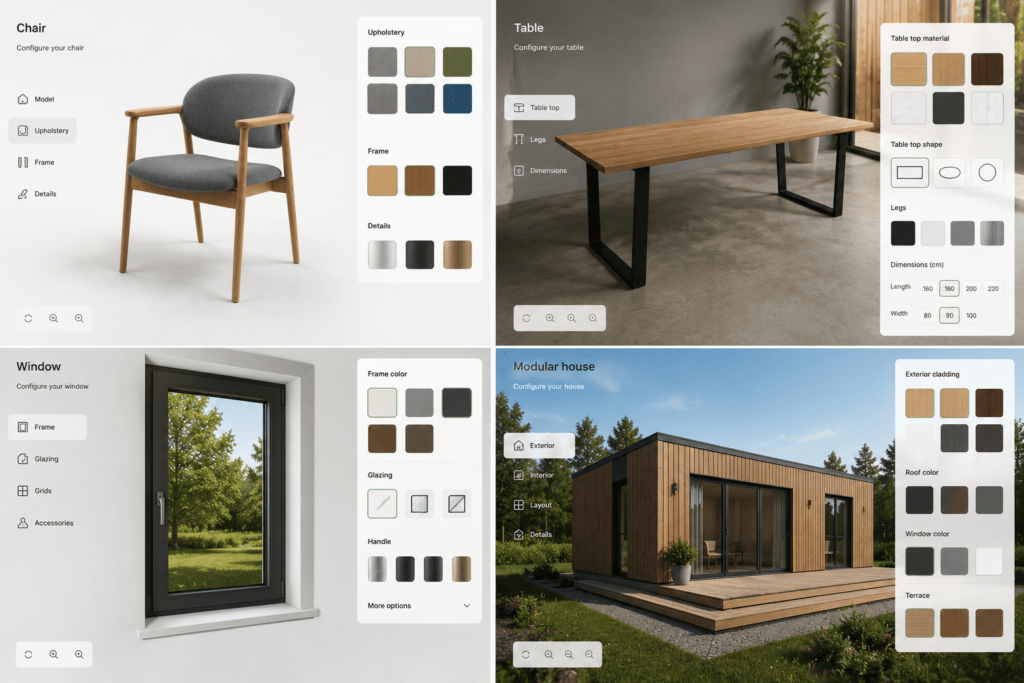
While the terminology varies across industries and markets, the underlying objective remains the same: helping customers understand configurable products before making a purchasing decision.
In North America, terms such as Product Configurator, Product Planner, Product Customization Tool, and Product Visualizer are commonly used. In Germany and other European markets, terms such as Produktkonfigurator, Produktvisualisierer, Online-Konfigurator, 3D-Planer, and Produktplanung are increasingly common.
IKEA provides a good example of how these tools are presented to consumers. Rather than focusing on technical terminology, IKEA often refers to its solutions as planning tools, room planners, or product planners. The objective is not to emphasize technology but to simplify decision-making.
The same principle applies across industries. Whether a customer is configuring a kitchen, selecting façade materials, designing modular buildings, specifying industrial equipment, or choosing furniture, the goal is always the same: making complex decisions easier to understand.
Product Configurators Use Different Types of Visual Content
One common misconception is that every product configurator must be built entirely around interactive 3D models. In reality, modern configurators can use different types of visual content depending on the product, the available assets, and the goals of the manufacturer.
Many companies already have extensive libraries of professional product photography that can be integrated into a configurator. Customers can switch between colours, materials, finishes, accessories, or product variants while viewing high-quality photographs. This approach is often both practical and cost-effective, particularly when products have a limited number of configurable options.
Other configurators combine photography with digitally created elements. Existing product images may be enhanced with new materials, additional product options, or visual overlays that extend the functionality of the original photography without requiring every possible variation to be photographed separately.
For products with a greater number of customization possibilities, interactive 3D models often provide the greatest flexibility. Customers can rotate products, explore them from different angles, change materials in real time, and immediately see the impact of each selection. Because a single 3D model can represent countless product combinations, this approach is particularly well suited to highly configurable products.
In many cases, the most effective solution is a combination of these techniques. Photography, 2D graphics, and 3D visualization can work together within the same configurator, providing the right balance between realism, flexibility, development time, and budget.
At Nordic Render, we select the visual approach based on the product itself rather than a predefined technology. Whether a project is best served by professional product photography, digitally enhanced imagery, fully interactive 3D models, or a hybrid solution, the objective remains the same: helping customers understand products more clearly and make confident purchasing decisions.
Research: Why Product Configurators Work
The growing adoption of product configurators is not simply a result of technological progress. Academic research increasingly demonstrates that visualization, customer participation, and user experience play important roles in purchasing decisions. Several recent studies provide valuable insights into why configurators have become such effective tools for customer communication and product selection.
Visualization Reduces Complexity
Visualization is one of the defining features of modern product configurators. Rather than simply presenting product information, it helps customers understand configurable products, compare alternatives, and make more confident purchasing decisions. Recent research by Petterle et al. (2024) suggests that visualization not only improves customer engagement but also supports decision-making by helping customers evaluate configurable products more effectively.
This finding has important practical implications. Customers are often asked to make decisions about products that do not yet exist in their final form. A customer selecting a façade system, a sofa, or a modular building must imagine how different materials, colours, and configurations will appear once combined. Without effective visualization, this process becomes more difficult, increasing uncertainty and making it harder to compare alternatives with confidence.
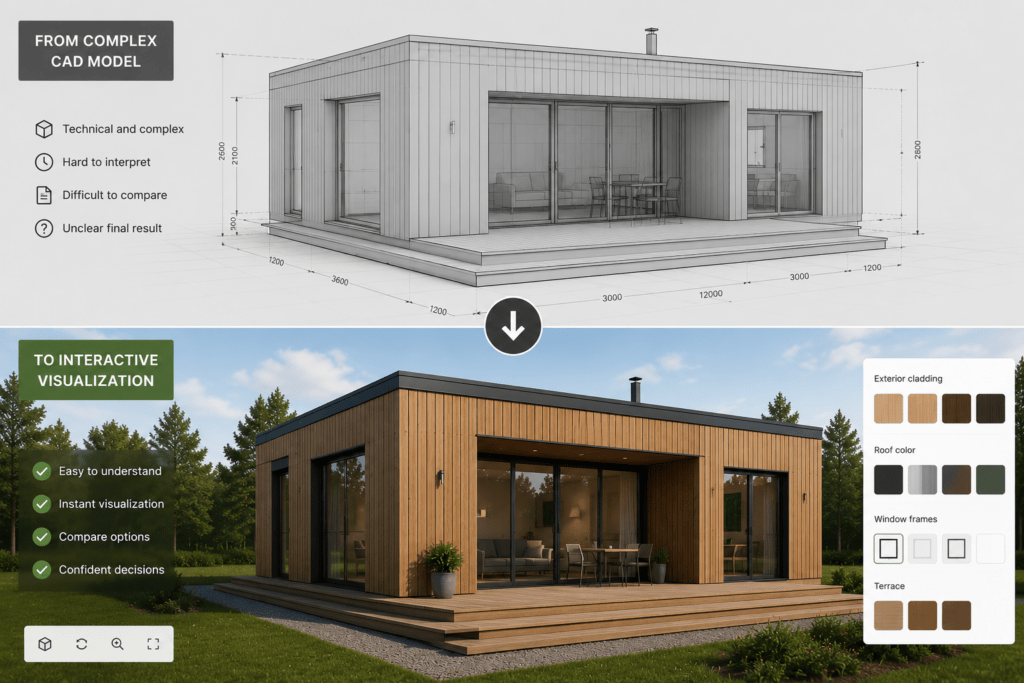
Visualization helps customers understand the consequences of their choices. It reduces uncertainty, simplifies comparison between alternatives, and allows buyers to evaluate options more efficiently.
For Nordic Render, this is where visual communication becomes central to the configurator experience. A configurator is only as effective as the visual content behind it. Realistic product models, accurate materials, and clear visual feedback transform technical product information into something customers can immediately understand.
User Experience Influences Purchase Decisions
These findings highlight an important principle: customers are not only evaluating the product itself—they are also evaluating the experience of configuring it. When a configurator is intuitive, visually clear, and easy to navigate, users are more likely to stay engaged, explore different options, and complete the configuration process. Conversely, a confusing interface or overly complicated workflow increases cognitive effort and can discourage further interaction.
A successful product configurator depends not only on the product it presents but also on the quality of the user experience it provides. Research by Yi et al. (2022) demonstrates that interaction design plays a significant role in shaping consumers’ customization experiences. The study found that factors such as navigation design, system usability, flexible navigation, and perceived control all influence how users experience the configuration process and interact with customizable products.
This distinction is particularly important because customers rarely separate the configurator experience from the product experience. Every interaction contributes to their perception of the brand, the product, and the quality of the solution being offered.
For this reason, successful configurators are not simply technical tools. They are carefully designed user experiences that guide customers through complex decisions in a clear, intuitive, and visually engaging way. The most effective solutions reduce friction, build confidence, and allow customers to focus on evaluating the product rather than learning how to use the software.
Customer Participation Strengthens Psychological Ownership
One of the greatest strengths of product configurators is that they transform customers from passive buyers into active participants. Rather than simply selecting a product from a catalogue, customers contribute to creating a solution that reflects their own preferences and requirements.
Research by Maier and Baccarella (2024) shows that customer participation can have important psychological and behavioral effects. When customers actively participate in creating or customizing a product, they often develop a stronger sense of psychological ownership. This personal involvement can increase purchase intention, willingness to pay, product demand, customer loyalty, and positive word-of-mouth communication.
For configurable products, this effect is particularly valuable. Customers are not simply choosing between predefined options—they are shaping the final product themselves. As they invest time and make decisions throughout the configuration process, they begin to perceive the product as uniquely their own.
This psychological shift changes the buying experience. Customers no longer feel like they are purchasing a standard product. Instead, they feel they are investing in a solution created specifically for their needs. As a result, configurators do more than simplify product selection—they strengthen customer engagement, increase confidence, and create a stronger connection between the customer, the product, and the brand.
Beyond Marketing: Why Manufacturers Invest in Configurators
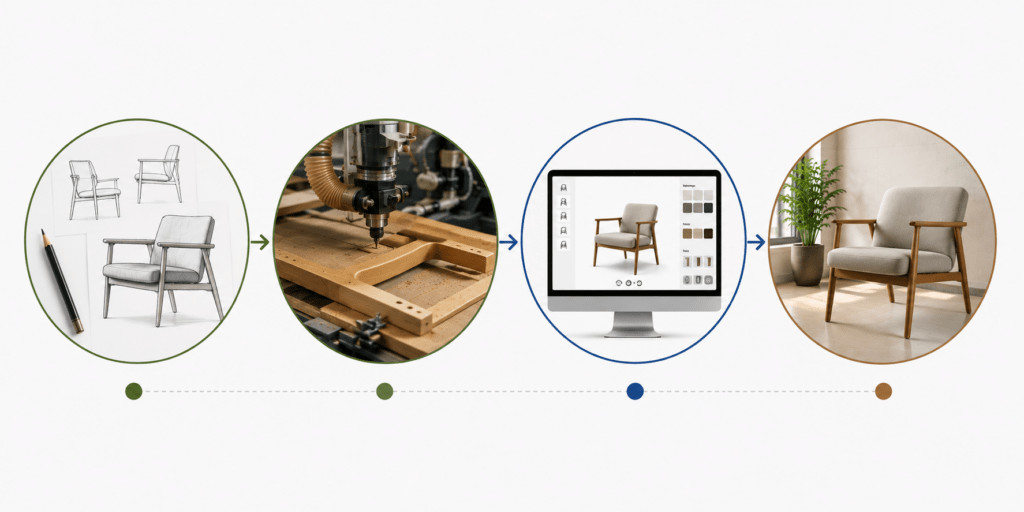
While product configurators are often associated with marketing and online sales, their value extends far beyond attracting customer attention. For many manufacturers, the primary challenge is managing product complexity and communicating accurate information consistently across sales, engineering, production, dealers, and customers.
Research by Campo Gay and Hvam (2021) highlights that configuration systems support both sales and engineering processes by digitalizing and automating decision-making. The authors also emphasize an important principle: successful configurators should be designed around the people who use them, not only around the products they represent.
This distinction is particularly relevant in B2B environments. The primary user of a configurator is not always the end customer. Depending on the sales process, it may be a salesperson preparing a quotation, an architect specifying building products, a distributor advising clients, or an engineer configuring a technically complex solution. Each user has different objectives, levels of expertise, and information requirements.
For this reason, an effective configurator is more than a digital product catalogue. It is a communication tool that presents the right information to the right user at the right stage of the decision-making process. By reducing unnecessary complexity and guiding users through the configuration process, manufacturers can improve efficiency, reduce errors, and create a more consistent product experience across the entire organisation.
As product portfolios continue to grow, configurators increasingly become shared business platforms rather than standalone sales tools. They help align product information, customer expectations, and internal workflows around a common understanding of the final product. For manufacturers offering configurable or engineered products, this makes the configurator an important part of how products are communicated, specified, and ultimately sold.
How Nordic Render Approaches Product Configurators
Many configurator providers focus primarily on software development, while many visualization studios concentrate on creating images, animations, and marketing content.
At Nordic Render, our expertise lies in bringing these disciplines together. This distinction matters because customers never experience the underlying software architecture directly. What they experience is the product itself—its materials, colours, finishes, dimensions, and available options. The quality of that experience depends not only on how well the configurator functions, but also on how effectively the product is presented and communicated.
A technically advanced configurator with weak visual content can struggle to communicate value. Equally, even the most beautiful product renderings cannot provide the interactivity and decision-making support that modern customers increasingly expect.
By combining expertise in product visualization, 3D content creation, user experience, and configurator development, Nordic Render helps manufacturers transform complex product information into intuitive and engaging digital experiences. The result is not simply a software tool, but a platform that helps customers understand products, explore possibilities, and make informed decisions.
This integrated approach also simplifies the process for clients. Instead of coordinating multiple suppliers for visualization, 3D content creation, configuration logic, and implementation, manufacturers can work with a single partner who understands both the technical and visual aspects of the customer journey.
From Product Data to Interactive Product Experiences
Every successful configurator begins long before the first line of code is written. Behind every interactive experience lies a structured process that transforms products into digital assets capable of supporting configuration, visualization, and customer interaction.
Understanding the Product
The first step is understanding how the product works. What options are available? Which combinations are possible? What rules and limitations exist? Which decisions are most important for customers?
A clear understanding of the product structure forms the foundation of every successful configurator. Without this stage, even technically advanced solutions can become confusing or difficult to use.
Creating Visual Assets
Once the product structure has been defined, the next step is creating the visual assets that will power the configurator. Depending on the product and the desired customer experience, these may include professional product photography, 2D graphics, digitally enhanced images, fully interactive 3D models, or a combination of these approaches.
The choice depends on several factors, including the complexity of the product, the level of customization, existing marketing materials, and project objectives. Many manufacturers already have high-quality product photography that can be incorporated into a configurator, while others benefit from creating new 3D assets that offer greater flexibility for products with numerous variants and configurable options.
Regardless of the visual approach, every asset must balance quality with performance. Products should appear realistic, accurately represent materials and finishes, and load quickly across desktop and mobile devices to ensure a smooth and engaging user experience.
For many manufacturers, this stage also creates long-term value. The same visual assets—whether photographs, enhanced imagery, or 3D models—can often be reused across websites, marketing campaigns, product animations, presentations, sales materials, and future interactive product experiences, making them a valuable investment beyond the configurator itself.
Building Materials and Variants
Materials, colors, finishes, fabrics, textures, and product variations are then prepared for configuration. This stage is particularly important because visual realism directly influences customer confidence. When customers are selecting materials or finishes, they need to trust that what they see accurately represents the final product.
Developing Configuration Logic
Configuration logic determines how products behave. Which options are compatible? Which dimensions are available? What happens when one selection affects another? Well-designed logic simplifies complex product structures and prevents invalid combinations, helping customers focus on meaningful choices rather than technical limitations.
Testing the User Experience
A configurator may function perfectly from a technical perspective and still fail to deliver a positive customer experience. For this reason, usability plays a central role throughout the development process. Every aspect of the customer journey—from navigation and option grouping to visual feedback and workflow design—must support intuitive decision-making rather than add complexity.
The objective is not to present customers with every available option as quickly as possible. Instead, it is to guide them through the process in a way that feels natural, logical, and effortless. The most successful configurators reduce uncertainty, build confidence, and help users focus on the product itself rather than the mechanics of the software.
Launch and Continuous Development
Product portfolios continue to evolve. New materials are introduced, additional product variants become available, and customer expectations change alongside advances in technology. For this reason, modern configurators should be viewed as scalable digital platforms rather than one-time projects. Businesses need solutions that can grow alongside their products, sales processes, and customer requirements.
At Nordic Render, we design configurators with long-term development in mind, allowing new products, materials, features, and configuration rules to be added as businesses expand. Our expertise extends beyond traditional configurator development. We continuously monitor advances in artificial intelligence, automation, visualization technologies, and digital product experiences to ensure that our clients benefit from emerging best practices and future opportunities.
While artificial intelligence is becoming increasingly important in product discovery, recommendation systems, and customer guidance, it does not replace the need for accurate product data, intelligent configuration logic, or realistic visualization. Instead, AI becomes most powerful when integrated into a well-structured configurator ecosystem.
By combining expertise in visualization, configurator development, and emerging AI technologies, Nordic Render helps manufacturers build solutions that are not only effective today but ready for the expectations of tomorrow’s customers.
Product Configurators Across Industries
Although product configurators are often associated with e-commerce, their applications extend far beyond online retail. Today, manufacturers across many industries use configurators to communicate complex products, support customer decision-making, and streamline internal sales and engineering processes. While the products themselves may differ, the underlying goal remains the same: helping customers understand configurable products before production begins.
Furniture Manufacturing
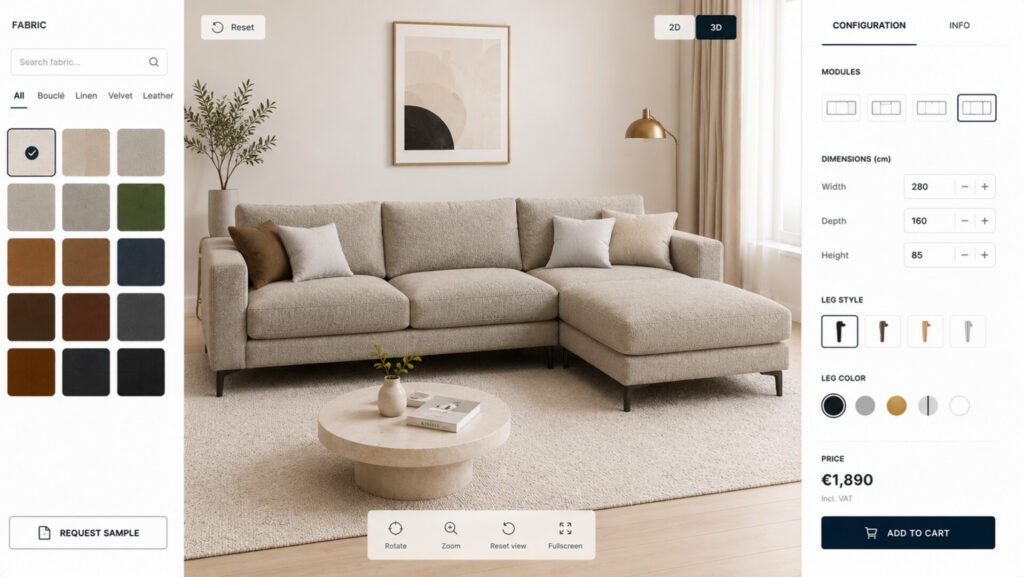
Furniture manufacturers often offer hundreds—or even thousands—of possible product combinations. Customers may choose between different fabrics, colours, wood finishes, dimensions, leg styles, accessories, and modular layouts. Presenting every variation through traditional product photography quickly becomes impractical, while printed catalogues often fail to communicate how different combinations will look together.
Product configurators allow customers to explore these possibilities interactively, visualizing changes instantly as they customize a product. This creates a more engaging buying experience while giving customers greater confidence in their decisions.
For manufacturers, configurators also simplify product communication by reducing the need for extensive image libraries, supporting consistent product presentation, and making large product portfolios easier to manage across websites, dealers, and marketing materials.
Windows, Doors, and Building Components
Manufacturers of windows, doors, façade elements, and other building components often offer a wide range of sizes, materials, glazing options, finishes, hardware, and technical specifications. Explaining these combinations through brochures or technical documentation alone can be difficult, particularly for customers who are unfamiliar with construction products.
Product configurators allow customers, architects, dealers, and sales representatives to compare product options visually while ensuring that technical requirements remain clear and consistent. Interactive visualization helps users understand how different configurations influence both the appearance and functionality of the final product.
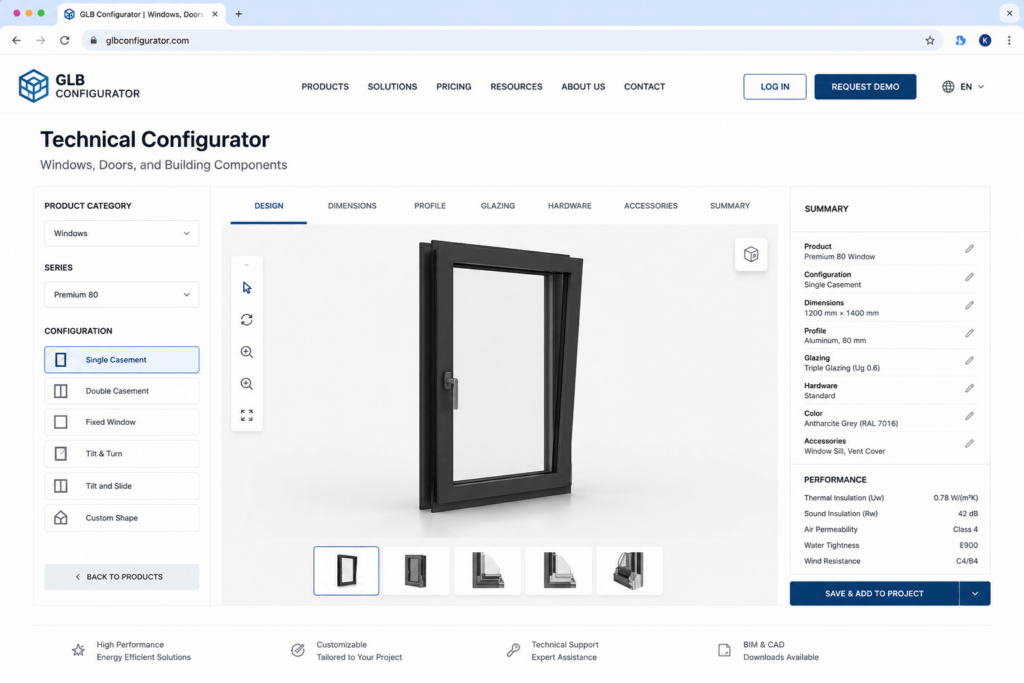
For manufacturers, configurators simplify quotation and specification processes, reduce the likelihood of incorrect selections, and provide a consistent way to present increasingly complex product portfolios across both B2B and B2C sales channels.
Building Products and Construction
Construction products are often technically complex and purchased infrequently, making them difficult for customers to evaluate using technical drawings, specification sheets, or printed brochures alone. Products such as façade systems, cladding, roofing solutions, insulation products, and structural building components frequently involve numerous material, colour, and design options that influence both performance and appearance.
Product configurators help simplify these decisions by allowing customers, architects, and specifiers to compare options visually before committing to a final solution. Interactive visualization reduces uncertainty, improves communication between stakeholders, and supports more informed discussions throughout the specification process.
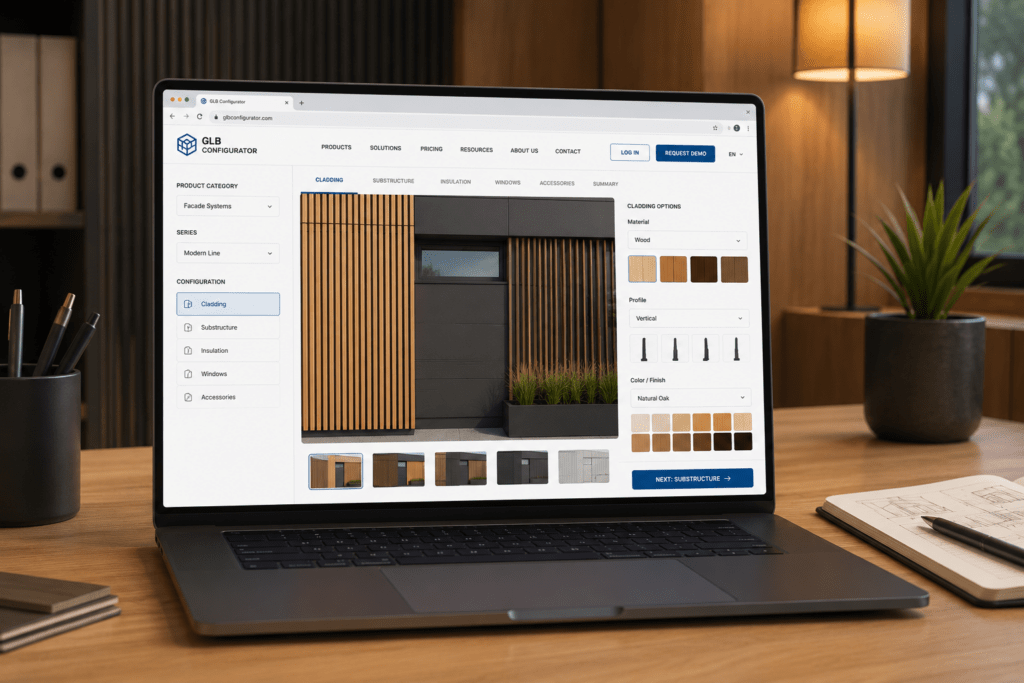
For manufacturers, configurators provide a consistent way to present product ranges while reducing misunderstandings and helping sales teams communicate technical solutions more effectively.
Modular Buildings and Prefabrication
Modular buildings present a unique communication challenge because customers are often making significant purchasing decisions before a physical building exists. Floor plans, technical drawings, and static renderings rarely provide enough information for customers to fully understand how different layouts, materials, façade options, or equipment choices will influence the final result.
Interactive configurators bridge this gap by allowing customers to explore configurable options in real time while immediately seeing the impact of their decisions. This creates greater confidence throughout the purchasing process and helps customers better understand products that are manufactured specifically to their requirements.
For manufacturers of prefabricated and modular buildings, configurators also improve quotation workflows, reduce specification errors, and provide a scalable way to communicate increasingly complex product portfolios.

Industrial Products and Equipment
Industrial products often involve sophisticated technical specifications, multiple component options, and numerous compatibility rules that can make the purchasing process challenging for both customers and sales teams. Traditional product documentation frequently requires users to navigate technical manuals, spreadsheets, and engineering documentation before arriving at a suitable configuration.
Product configurators organize this complexity into a structured, step-by-step process that guides users through available options while preventing incompatible selections. This not only improves the customer experience but also supports internal engineering and sales processes by generating clearer and more consistent product specifications.
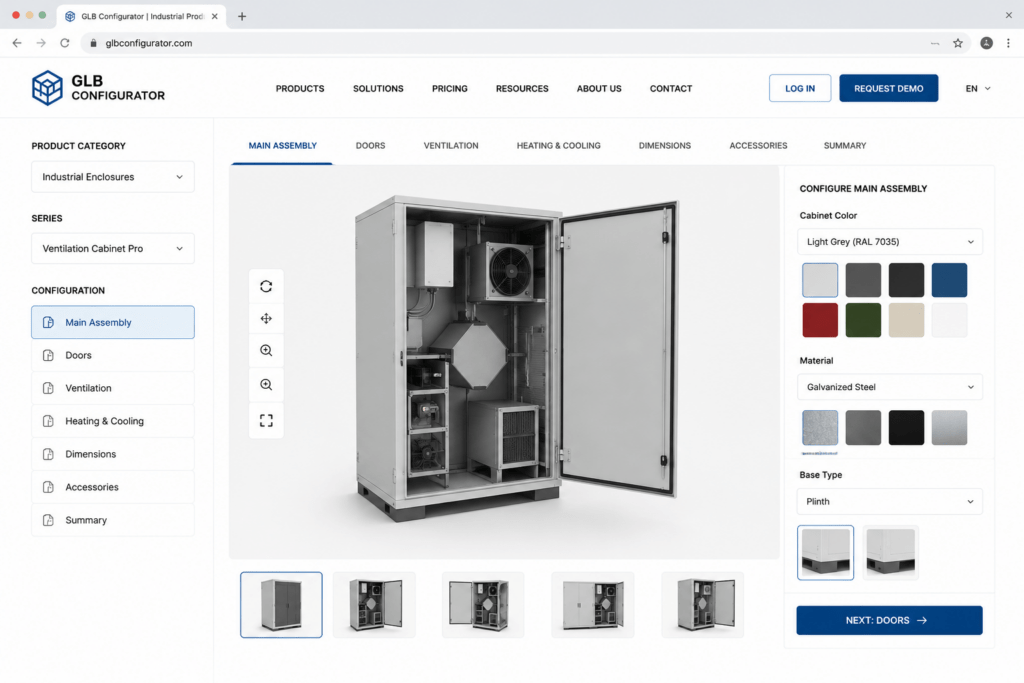
For manufacturers, configurators reduce repetitive sales work, improve quotation accuracy, minimize costly configuration errors, and create a more efficient workflow from the first customer inquiry through production.
Why GLB Technology Matters
Behind every successful product configurator lies a balance between visual quality and technical performance. Customers expect products to load quickly, respond instantly, and work seamlessly across desktop and mobile devices. At the same time, manufacturers need realistic digital representations that accurately communicate materials, dimensions, finishes, and product variations. This is one reason why the GLB file format has become an important foundation for modern web-based configurators.
GLB is the compact binary version of the glTF standard, designed for efficient storage, transmission, and loading of 3D assets. By packaging geometry, materials, textures, and other data into a single file, GLB provides an efficient format for interactive 3D applications, including web-based product configurators. Unlike many traditional 3D formats used for design and content creation, GLB models can be delivered directly through modern web-based 3D viewers and configurators, allowing customers to explore and configure products in their browser without installing additional software or plugins.
Although customers may never notice the technology behind the experience, they immediately benefit from it. Fast loading times, smooth interaction, and consistent performance across different devices make product exploration more intuitive and enjoyable. For manufacturers, GLB provides an effective way to combine high-quality 3D visualization with scalable, browser-based configurator solutions.
At Nordic Render, GLB technology forms a key part of our configurator ecosystem and is the foundation of our own GLBConfigurator platform. By combining realistic visualization with efficient web delivery, we create interactive product experiences that are visually engaging, responsive, and accessible across a wide range of devices. Because we develop both the platform and the 3D content, we can optimise every aspect of the user experience—from the quality of the models to the way customers interact with configurable products.
If you would like to learn more about the technology behind our platform and how GLB supports modern interactive product experiences, explore our guide to GLB Configurator for Manufacturers.
As digital product experiences continue to evolve, web-optimised formats such as GLB will play an increasingly important role in helping manufacturers present complex products through fast, interactive, and visually compelling online experiences.
From Experience to Platform: Introducing GLBConfigurator
Throughout this guide, we have explored how product configurators combine visualization, user experience, and intelligent product logic to help customers understand complex products and make more confident decisions. These same principles form the foundation of GLBConfigurator, Nordic Render’s web-based product configurator platform.
Developed through years of experience working with manufacturers across the furniture, construction, industrial, and modular building sectors, GLBConfigurator brings together realistic visualization, intuitive interaction, and efficient web technologies in a single solution. Rather than requiring complex software installations, the platform is designed to integrate easily with existing websites while delivering fast, responsive product experiences across desktop and mobile devices.
Built on the GLB file format, GLBConfigurator is designed for products with numerous materials, colours, finishes, components, and configurable options. Customers can rotate products freely, explore them from different angles, and change materials, finishes, colours, and product variants in real time. This creates an interactive product experience that helps customers better understand complex products and make more informed purchasing decisions.
Because Nordic Render develops both the visual content and the configurator itself, clients benefit from a single partner throughout the entire implementation process, including:
- Product analysis
- Visual asset creation (photography, enhanced imagery, or 3D)
- Material and finish libraries
- Configuration logic
- User experience design
- Platform implementation
- Ongoing development and support
As digital product experiences continue to evolve, GLBConfigurator is designed to support future technologies such as AI-assisted product guidance, intelligent recommendations, augmented reality, and other interactive customer experiences. This enables manufacturers to build on a scalable foundation as customer expectations and digital technologies continue to develop.
Explore GLBConfigurator: https://glbconfigurator.com
The Future of Product Configuration
The next generation of product configurators will not simply offer more options—they will become increasingly intelligent, personalized, and integrated into broader digital customer journeys. Artificial intelligence is already changing how products are discovered, compared, and configured. Recommendation engines can suggest suitable product combinations, identify compatible options, answer customer questions, and guide users through increasingly complex product portfolios.
However, AI does not replace the configurator itself. Even the most advanced AI systems rely on accurate product data, configuration rules, engineering constraints, pricing structures, and high-quality visual assets. Without this foundation, AI cannot generate reliable recommendations or meaningful customer experiences.
For this reason, the future of product configuration is not a choice between AI and configurators. Instead, the two technologies will increasingly work together to combine:
- Intelligent AI-powered guidance
- Accurate configuration logic
- High-quality visual communication
Together, these capabilities will enable manufacturers to create faster, more personalized, and more engaging product experiences while helping customers make confident purchasing decisions. The most successful configurators of the future will not simply be smarter—they will make increasingly complex products easier to understand.
From Knowledge to Practical Solutions
Throughout this guide, we have explored the research, principles, and technologies that make modern product configurators effective. However, creating a successful configurator requires far more than software development alone. It requires a deep understanding of products, customers, visual communication, and the decision-making process.
For more than a decade, Nordic Render has helped manufacturers, furniture brands, construction companies, and industrial businesses communicate products that are often technically complex, highly configurable, or difficult to explain through traditional marketing materials. Through architectural visualization, product rendering, animation, interactive experiences, and configurator development, we have gained practical insight into how customers understand products and make purchasing decisions.
Our experience spans multiple industries, each with its own products, configuration logic, and customer requirements. While every project is different, the goal remains the same: helping customers understand complex products through intuitive interactive experiences.
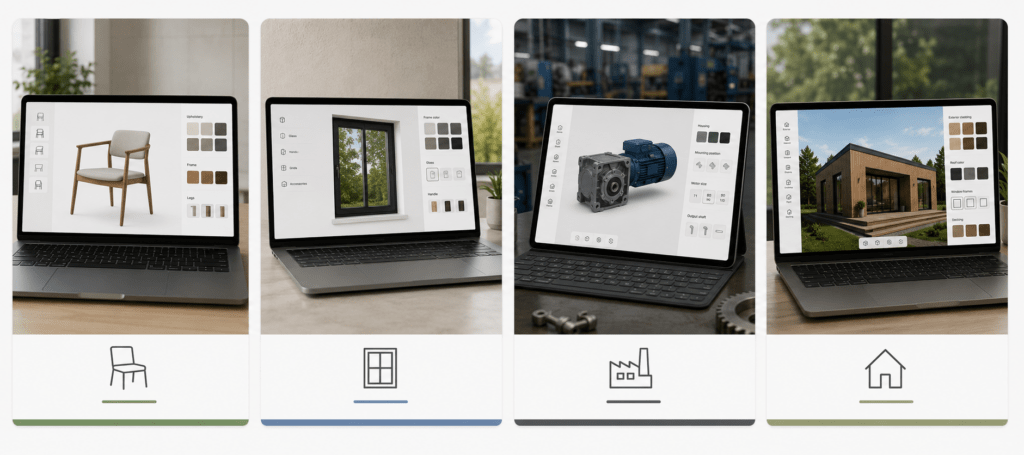
This experience shapes every configurator project we develop. Rather than starting with technology, we begin by understanding the product and the people who will use the configurator. What information do customers need? Which decisions create the most uncertainty? How can visual communication simplify complex choices? Only then do we determine the most appropriate combination of visual assets, configuration logic, user experience, and technologies.
Because Nordic Render develops both the visual content and the configurator itself, clients benefit from a single partner throughout the entire implementation process—from product analysis and visual asset creation to user experience, configuration logic, implementation, and future development.
As digital product technologies continue to evolve, we help clients evaluate and implement the solutions that best support their products, customers, and business goals. Rather than adopting new technologies for their own sake, we focus on practical applications that improve product communication and create measurable value.
Ultimately, successful configurators are not defined by the technology behind them. They are defined by how effectively they help people understand products, make confident decisions, and move from interest to purchase.
Conclusion
As products become increasingly customizable and product portfolios continue to expand, helping customers understand available options is becoming just as important as the products themselves. Research consistently shows that visualization, user experience, and customer participation influence purchasing decisions. Product configurators bring these elements together by transforming technical information into interactive experiences that customers can explore, understand, and trust.
For manufacturers, the benefits extend far beyond marketing. Configurators can improve communication, reduce misunderstandings, support sales processes, and simplify the specification of complex products. They help align customer expectations with product reality while creating a more engaging and efficient buying experience.
At Nordic Render, we believe that the most effective configurators are not simply software tools. They are communication tools. Their purpose is to make complex products easier to understand and easier to sell. By combining expertise in visualization, configurator development, user experience, and emerging technologies, we help manufacturers create digital product experiences that support customers throughout the decision-making process.
As customer expectations continue to evolve, product configurators are becoming an increasingly important part of how products are presented, understood, and ultimately chosen.
Frequently Asked Questions
What Is a Product Configurator?
A product configurator is an interactive digital tool that allows customers to customize products by selecting options such as materials, colours, dimensions, features, and configurations while instantly visualizing the result. Product configurators transform complex product information into an interactive experience that is easier to understand than traditional catalogues or product datasheets.
What Is the Difference Between a Product Configurator and a Product Visualizer?
A product visualizer focuses on displaying different product options and variations, allowing customers to view materials, colours, finishes, or design alternatives. A product configurator goes one step further by enabling customers to actively customize products according to predefined rules, available options, and technical limitations. In many modern solutions, visualization and configuration are combined into a single interactive experience.
What Industries Benefit Most from Product Configurators?
Product configurators can be valuable in almost any industry that offers multiple product options or customization possibilities. Common applications include furniture manufacturing, building products, modular construction, prefabricated buildings, industrial equipment, technical products, consumer goods, and architectural products. Whenever customers need help comparing options and understanding product variations, a configurator can improve the decision-making process.
What Is a Furniture Configurator?
A furniture configurator allows customers to customize furniture products by selecting materials, fabrics, colours, dimensions, modules, and accessories while instantly viewing the result. Furniture manufacturers often use configurators to present a wide range of product combinations without needing separate product photography for every possible variation. Customers benefit from greater confidence in their choices, while manufacturers gain a more scalable way to present customizable products.
What Is a Modular Building Configurator?
A modular building configurator enables customers to explore different building layouts, materials, façade options, roof designs, and other customizable features before construction begins. These tools are particularly valuable in modular and prefabricated construction because customers often need to make important decisions long before a physical building exists. Visualization helps bridge this gap by making design choices easier to understand.
What Is a Configurator for Building Products?
Configurators for building products are commonly used for façades, cladding systems, windows, doors, roofing products, flooring, and other architectural elements. They allow architects, contractors, developers, and end customers to compare materials, colours, finishes, and product options in a visual and interactive way. This simplifies product selection while reducing misunderstandings during the planning and specification process.
What Is a 3D Configurator?
A 3D configurator combines product customization with real-time 3D visualization. As customers change options such as materials, dimensions, or colours, the product updates instantly on screen. This creates a more engaging and realistic experience than static product images and helps customers better understand the impact of their selections.
Can Product Configurators Use Product Photography Instead of 3D Models?
Yes. Product configurators do not always require fully interactive 3D models. Depending on the product, customer journey, and level of customization, configurators can use professional product photography, 2D graphics, enhanced images, fully interactive 3D models, or a combination of these approaches.
Many manufacturers already have extensive libraries of high-quality product photographs that can be incorporated into a configurator. In other cases, photography can be enhanced with digital elements or combined with 3D visualization to create a more interactive experience without replacing existing visual assets.
The most appropriate solution depends on the complexity of the product, the number of configurable options, the desired customer experience, and the project budget. The objective is not to use 3D wherever possible, but to select the visual approach that communicates the product most effectively while supporting business goals.
What Is a GLB Configurator?
A GLB configurator uses lightweight GLB 3D models to display and configure products directly within a web browser. GLB technology allows realistic product visualization while maintaining fast loading times and excellent performance across desktop and mobile devices. Because GLB files are optimized for the web, they are increasingly used in modern product configurators and digital product experiences.
How Long Does It Take to Develop a Configurator?
The development timeline depends on product complexity, the number of configurable options, required integrations, and the amount of visual content involved. A simple product configurator may be completed within a few weeks, while larger projects involving complex logic, multiple product families, or custom integrations can take several months. The most important factor is ensuring that the configurator accurately reflects the product and provides an intuitive user experience.
Do Product Configurators Always Require Complex Software?
No. Product configurators do not always require large or complex software implementations. The right solution depends on the product, the level of customization, the desired customer experience, and the project’s business objectives.
Some configurators are simple browser-based applications designed to showcase a single product with a limited number of configurable options. Others integrate with ERP systems, CRM platforms, pricing engines, product databases, or manufacturing workflows to support highly complex products and sales processes.
Many manufacturers choose to start with a smaller solution for one product or product family and expand the configurator over time as their digital capabilities and business needs grow. This phased approach reduces implementation risk while allowing the configurator to evolve alongside the business.
Can Product Configurators Be Integrated into Existing Websites?
Yes. Most modern configurators can be integrated into existing websites, e-commerce platforms, customer portals, and sales environments. Depending on project requirements, they can also be connected to CRM systems, ERP software, product databases, quotation tools, and other business systems.
Can Pricing and Quotations Be Automated?
Yes. Many configurators can automatically calculate pricing based on customer selections and generate quotations, product specifications, or bills of materials. This helps streamline sales processes, improve consistency, reduce manual work, and accelerate response times for both customers and sales teams.
Do Product Configurators Work on Mobile Devices?
Modern web-based configurators are designed to work across desktop computers, tablets, and smartphones. Mobile compatibility is increasingly important as customers expect to research, compare, and configure products seamlessly across multiple devices throughout the buying process.
Can AI Replace Product Configurators?
Artificial intelligence is already transforming how product configurators are developed, managed, and experienced. AI can assist with coding, automate parts of the development process, generate intelligent recommendations, and help customers navigate increasingly complex product choices.
However, the need for product configuration itself is not disappearing. Manufacturers still require accurate product data, configuration rules, engineering constraints, pricing structures, and realistic visual representations of their products. Whether a configurator is developed by software engineers, created with AI assistance, or built through a combination of both, the underlying product logic and user experience remain essential.
The future is unlikely to be a choice between AI and configurators. Instead, AI will increasingly become part of the configurator experience, helping customers discover products, compare alternatives, receive personalized recommendations, and make decisions more efficiently.
For businesses, the real challenge is no longer simply building software. It is creating accurate, intuitive, and visually engaging product experiences that help customers understand increasingly complex products.
Can Nordic Render Create Both the Visual Content and the Configurator?
Yes. Nordic Render develops both the visual content and the configurator itself, providing a complete solution from a single partner. This includes product analysis, product photography, enhanced imagery, 3D modelling, material creation, visualization, configuration logic, user experience design, implementation, and ongoing development.
By combining expertise in visual communication and configurator development, Nordic Render helps manufacturers create interactive product experiences that improve customer understanding, simplify product communication, and support business goals.
References
Campo Gay, I., & Hvam, L. (2021). Integrating user-centered practices in configuration systems development: Framework and conceptual modelling. In Proceedings of the 23rd International Configuration Workshop (pp. 58- 64) https://backend.orbit.dtu.dk/ws/portalfiles/portal/258077395/51_ICG_ConfWS21_paper_1.pdf
Maier, Lukas, and Christian V. Baccarella. 2025. “The Psychological and Behavioral Consequences of Customer Empowerment in New Product Development: Situational Framework, Review, and Research Agenda.” Journal of Product Innovation Management 42(1): 220–252. https://doi.org/10.1111/jpim.12734
Petterle, A., Sandrin, E., & Forza, C. (2024). Product visualization in configurators: Laying the foundations for a comparative description. In Proceedings of the 26th International Workshop on Configuration (ConfWS 2024) (CEUR Workshop Proceedings, Vol. 3812). CEUR-WS. https://ceur-ws.org/Vol-3812/paper8.pdf
Yi, M., Huang, Z., & Yu, Y. (2022). Creating a sustainable e-commerce environment: The impact of product configurator interaction design on consumer personalized customization experience. Sustainability, 14(23), 15903. https://doi.org/10.3390/su142315903