
Explaining Complexity Through Motion
Published on 24. Jul 2026

Nordic Render Editorial Team
This article is part of Nordic Render’s Knowledge Guides, a collection of articles featuring practical experience, industry expertise and insights into business visualization, interactive experiences and digital technologies.
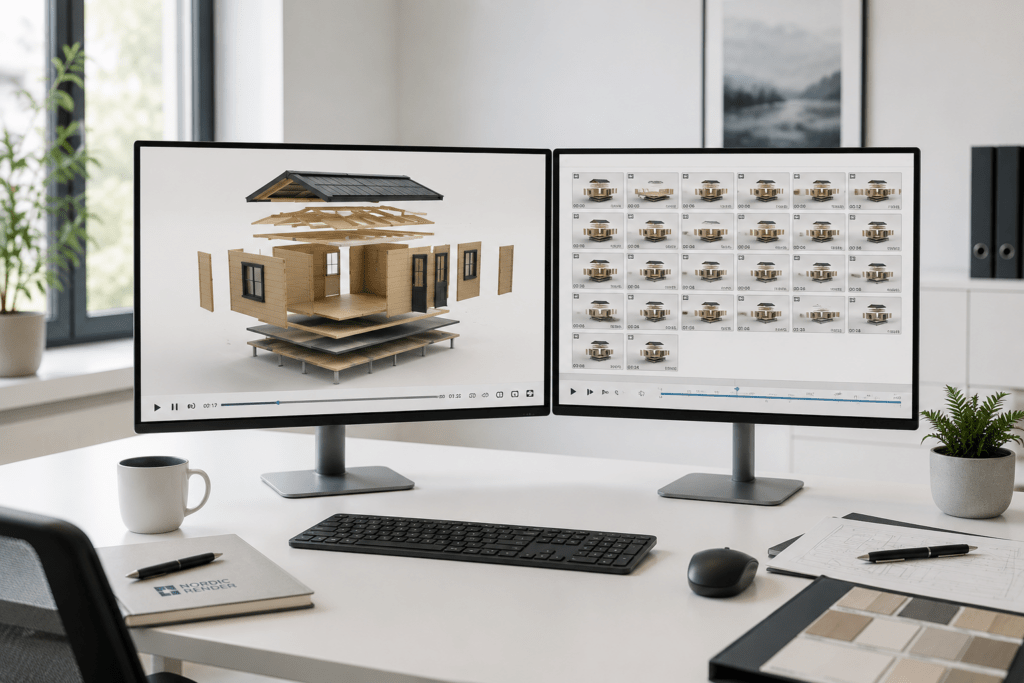
Modern products, buildings and industrial systems are becoming increasingly sophisticated. At the same time, customers, employees and project stakeholders expect to understand them more quickly than ever before. Explaining that complexity has become one of the central challenges of modern business communication.
Visual communication has become increasingly important, yet many of the concepts organisations need to explain remain inherently dynamic. Products are assembled rather than simply viewed. Manufacturing processes unfold over time. Machines operate through sequences of interconnected movements. Buildings are experienced by moving through them rather than from a single viewpoint. Static images can illustrate individual moments, but they often struggle to communicate how something works, changes or interacts.
Animation is one of the most effective ways of addressing this challenge because it introduces time as a dimension of communication. Rather than presenting isolated visuals, animation explains relationships, movement, cause and effect, making complex information easier to understand across marketing, sales, engineering, training and customer support.
Business animation is the use of animated visual content to explain products, processes, spaces and ideas for marketing, sales, engineering, training and customer communication.
Today, animation supports organisations throughout the entire customer and product lifecycle—from presenting concepts before production begins to explaining products, supporting sales, training employees and communicating complex technical information long after installation. While technologies continue to evolve, the underlying objective remains remarkably consistent: helping people understand information that would otherwise be difficult to communicate.
Why Business Animation Works
Animation is often valued for its visual impact, yet decades of educational and cognitive research suggest that its greatest contribution lies in improving understanding. When used appropriately, animation helps viewers grasp concepts involving behaviour, transformation and sequential change.
Unlike static illustrations, animation reveals how individual components interact over time, making invisible processes visible while reducing the need for viewers to mentally reconstruct how events unfold from a series of static images. This is particularly valuable when explaining mechanical systems, installation procedures, manufacturing workflows or spatial relationships.
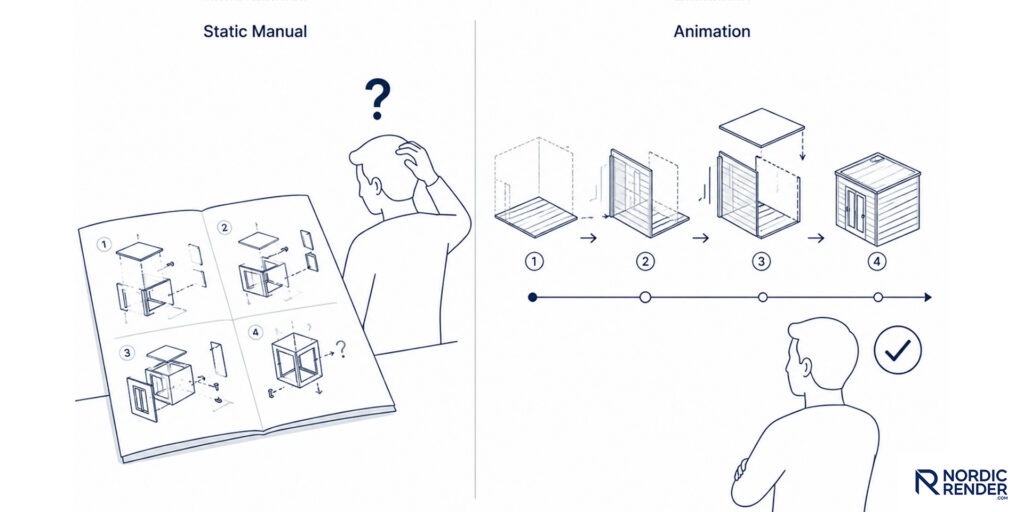
A comprehensive review of research into computer-animated learning materials concluded that animation is most effective when explaining dynamic concepts and procedural knowledge, particularly where understanding depends on observing change rather than memorising static information (Kleftodimos, 2024). The review also highlights that the effectiveness of animation depends on thoughtful design, with well-structured animations supporting learning more effectively than those that overload viewers with unnecessary information.
Although this research originates in educational settings, the underlying cognitive principles apply equally to business communication. Customers evaluating complex products, engineers reviewing manufacturing concepts and technicians learning installation procedures all face similar challenges: understanding how something works before making a decision or performing a task.
For businesses communicating increasingly complex products and processes, animation therefore serves a practical purpose. Rather than simply making content more visually engaging, it helps transform technical information into explanations that are easier to understand, remember and apply.
From Learning Theory to Industrial Communication
Many of the principles established through educational research are equally relevant to industrial communication. As products become more configurable and manufacturing systems more sophisticated, organisations must communicate increasingly complex information while ensuring it remains clear, consistent and accessible to diverse audiences.
Recent research examining visualisation in manufacturing and operations management identifies visual communication as a key enabler of decision-making, collaboration and knowledge transfer throughout industrial organisations. Rather than serving only an illustrative role, visualisation helps reduce complexity, build shared understanding and support more informed decisions across multidisciplinary teams (Lindner et al., 2025).
This shift is already visible across manufacturing and engineering industries. Technical knowledge is no longer created exclusively for engineers. Sales teams, distributors, architects, installers, procurement specialists and end customers increasingly rely on the same core information, presented at different levels of detail and adapted to different contexts.
Animation provides a common visual language capable of bridging these audiences without oversimplifying the underlying technical content. The same animation can support product launches, customer education, technical documentation, internal training and after-sales support, creating consistent communication throughout the customer journey while reducing the need to create separate explanatory materials for each audience.
Communicating Processes Rather Than Objects
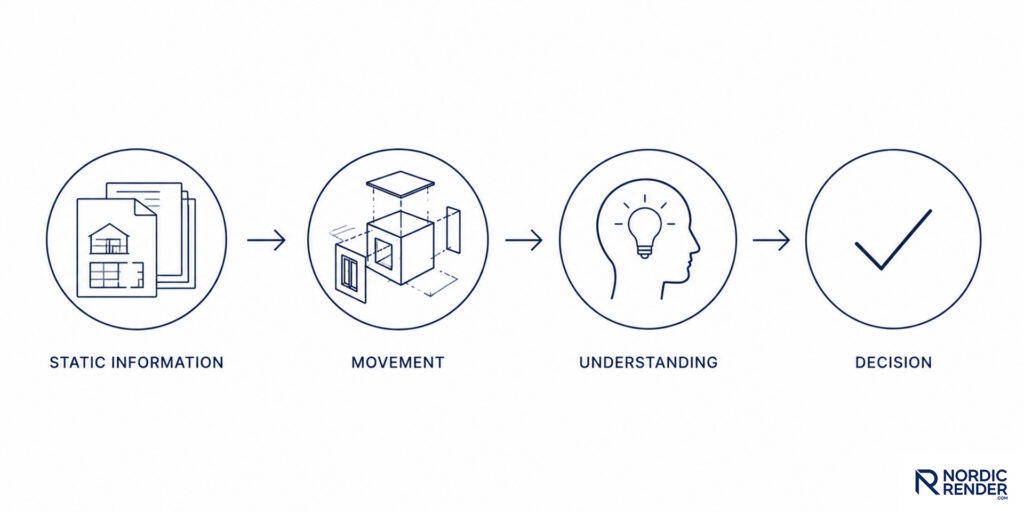
Many business decisions depend less on understanding what something looks like than on understanding what happens. They depend on understanding how a product is assembled, how a machine operates, how a configuration changes functionality or how a construction project evolves over time. These are questions about processes rather than objects, making animation particularly effective as a communication medium.
Research on animated process visualisation shows that animation can improve the comprehension of complex workflows by making dynamic process behaviour more explicit. Rather than requiring viewers to mentally reconstruct movement and sequences from static representations, animation reduces cognitive load—the mental effort required to process and understand information—by presenting changes and temporal relationships directly (Aysolmaz & Reijers, 2021).
The same principle applies across manufacturing, architecture and product communication. Whether explaining an installation sequence, demonstrating product functionality or visualising a construction schedule, animation allows viewers to observe progression rather than reconstruct it mentally from a series of separate images.
Beyond Marketing: A Business Communication Tool
Animation is frequently associated with promotional videos, yet its practical applications extend far beyond marketing. Manufacturers use animation to explain configurable products before purchase, demonstrate maintenance procedures after installation and support internal training programmes. Architects communicate projects long before construction begins. Engineering companies illustrate systems that cannot easily be photographed, while industrial organisations increasingly integrate animation into technical documentation, digital presentations and interactive product experiences.
Industry market analyses indicate that animation technologies are being adopted across manufacturing, engineering, healthcare, education, architecture and other sectors, reflecting their growing role as practical tools for communication, training and knowledge transfer rather than purely creative media (ResearchAndMarkets, 2025).
The technology itself continues to evolve through real-time rendering, web-based interactive experiences and emerging technologies such as artificial intelligence. The underlying purpose, however, remains unchanged. Effective business animation is not defined by visual effects or production complexity, but by its ability to improve understanding, support decisions and communicate information that static media cannot fully explain.
As part of a broader business visualisation strategy, animation enables organisations to communicate products, processes and ideas with greater clarity throughout the customer journey. Ultimately, its value is measured not by visual sophistication, but by how effectively it helps audiences understand, make informed decisions and act with confidence.
Business Animation in Practice
The applications of animation are remarkably diverse, yet the underlying objective remains the same: helping people understand information that would otherwise be difficult to explain.
Different industries use animation in different ways, but the communication challenges are often surprisingly similar. Whether presenting a configurable product, explaining a manufacturing process or introducing a future development project, organisations rely on animation when understanding depends on movement, sequence or change rather than appearance alone.
Explaining Products
Many products cannot be fully understood through photography or technical drawings alone. Industrial equipment, modular furniture, building systems and configurable products often contain moving parts, interchangeable components or features whose purpose only becomes clear when they are seen in operation.
Animation allows manufacturers to demonstrate functionality rather than simply appearance. Components can be assembled step by step, mechanisms can be revealed through exploded or cutaway views, and product features can be presented in the context in which they are actually used.
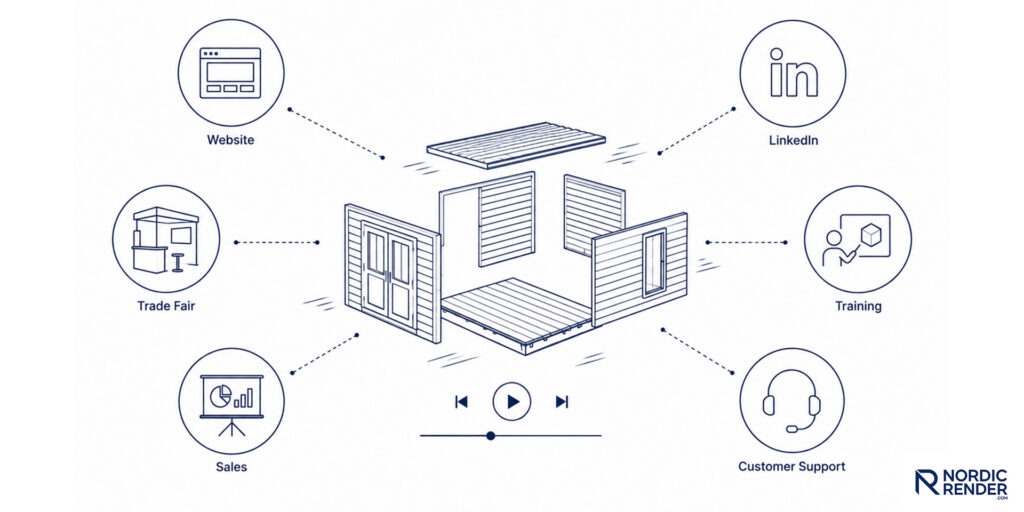
For customers, this reduces uncertainty during the buying process. Instead of interpreting specifications or imagining how a product functions, they can observe it directly. For manufacturers, the same visual assets support websites, sales presentations, exhibitions and customer communication, ensuring technical information is presented consistently across every touchpoint. Rather than replacing product photography or interactive product configurators, animation complements them by explaining what static media cannot: movement, interaction and function.
Explaining Technical Processes
Some of the most valuable animations are never intended for marketing. Installation procedures, manufacturing workflows, maintenance operations and production sequences often involve multiple stages that are difficult to communicate through static documentation alone. Manuals, drawings and written instructions remain essential, but animation provides an additional layer of understanding by showing how individual actions relate to one another over time.
This becomes particularly valuable when communicating procedures involving movement, timing or spatial relationships. Assembly instructions become easier to follow, maintenance procedures become more intuitive and manufacturing processes can be understood without requiring lengthy explanations.
Technical animation also helps reduce ambiguity. Instead of interpreting a series of separate illustrations, viewers observe the complete sequence exactly as it should occur, improving consistency while supporting training, installation and ongoing operations.
Learn more: Technical animation includes a wide range of applications, from assembly and installation animations to maintenance procedures, product operation and process visualisation. Explore our guide Technical Animation: Explaining Products, Processes and Installation, featuring practical examples from manufacturing and construction.
Supporting Learning and Knowledge Transfer
Every organisation depends on transferring knowledge. New employees learn production processes. Customers learn how products operate. Service technicians learn maintenance procedures. Distribution partners learn installation methods. As products become more sophisticated, communicating this knowledge effectively becomes increasingly important.
Animated content provides a consistent and repeatable way of supporting learning throughout the organisation. Complex procedures can be replayed whenever needed, dangerous operations can be demonstrated safely and technical concepts can be communicated visually rather than relying entirely on written documentation.
Knowledge transfer has also become a strategic challenge for many manufacturers. Experienced specialists retire, products evolve and technical expertise accumulated over decades must be shared with new employees and partners. Animation helps transform specialist knowledge into visual resources that remain accessible long after individual experts have left the organisation.
Visualising Future Spaces
Architecture, construction and real estate are fundamentally about communicating places that do not yet exist. Before construction begins, architects, developers and investors must evaluate projects based on drawings, plans and technical documentation. While these materials remain indispensable, they often require considerable experience to interpret.
Animation introduces a more intuitive perspective by allowing viewers to experience future environments through movement. Walkthroughs reveal how spaces connect, how people move through buildings and how projects relate to their surroundings. Construction sequences can illustrate how developments evolve over time, while infrastructure projects can communicate complex phasing in ways that static plans rarely achieve.
For project teams, clients, investors and public authorities alike, animation becomes a shared communication tool that supports discussion and decision-making long before construction begins.
Communicating Value
Animation is equally valuable when organisations need to explain ideas rather than procedures. New products, innovative technologies and complex solutions often require more than specifications or marketing claims to demonstrate their value. Customers want to understand how a solution fits into their own environment, what problems it solves and why it differs from existing alternatives.
Animated content enables organisations to tell that story visually. Rather than listing features, it demonstrates outcomes. Instead of describing functionality, it shows products solving real-world challenges. Technical capabilities become easier to understand because they are presented within meaningful scenarios rather than as isolated specifications.
Whether used on company websites, during product launches, at trade fairs, in investor presentations or across digital marketing channels, animation helps transform complex technical information into compelling business communication.
For many organisations, the value of business animation extends well beyond a single campaign. The same visual content can support product launches, sales presentations, trade fairs, social media, customer onboarding and technical communication, creating a consistent visual language throughout the customer journey while reducing the need to produce separate content for every channel.
One Communication Challenge, Many Visual Solutions
Although business animations take many forms, they all serve the same purpose: helping people understand information that static media cannot fully explain. Sometimes a short product animation provides the clearest explanation. In other situations, an exploded assembly sequence, a construction walkthrough, an installation guide or an interactive 3D experience communicates the message more effectively.
The decision is therefore rarely about choosing animation as a technology. It is about selecting the visual approach that best supports the communication objective. In practice, organisations increasingly combine multiple forms of business visualisation. Photorealistic renderings introduce products and spaces. Animation explains movement and processes. Interactive product experiences encourage exploration and comparison. Virtual tours create spatial understanding, while technical illustrations continue supporting detailed documentation.
Viewed in this context, business animation is not a standalone deliverable but one element within a broader visual communication strategy. The most effective organisations combine different visual methods according to the information they need to communicate, creating experiences that help customers, employees and stakeholders understand products, processes, spaces and ideas with greater confidence.
Building a Business Animation Strategy
As organisations increasingly adopt visual communication, the question is no longer whether animation has value, but how it should be used most effectively. Successful animation rarely begins with technology or software. It begins by identifying what people need to understand.
The most effective visual communication strategies focus on solving communication challenges rather than producing individual visual assets. Once that objective is clear, organisations can choose the visual approach that communicates information with the greatest clarity.
Start with the Communication Challenge
A common misconception is that every communication problem requires an animation. In practice, the opposite is often true. The first question should not be “Do we need an animation?” but rather “What are we trying to explain?”
Sometimes a single photorealistic rendering communicates a product perfectly. In other situations, an interactive product experience allows customers to explore different configurations at their own pace. When the objective is to demonstrate movement, explain a process or illustrate change over time, animation often becomes the most effective solution.
By starting with the communication objective rather than the technology, businesses can select visual solutions that genuinely improve understanding instead of simply adding visual complexity.
Choosing the Right Visual Approach
Business animation is one of many visual communication tools available to modern organisations. The most effective approach depends on the information being communicated, the intended audience and the stage of the customer journey.
Static renderings remain highly effective for communicating design, materials and atmosphere. Animation explains movement, functionality and processes. Interactive product experiences allow users to explore products independently, while virtual tours create spatial understanding by allowing viewers to navigate environments at their own pace.
In many cases, these approaches work best together rather than independently. A product may first be introduced through high-quality renderings, explained through animation and then explored further using an interactive configurator. Each visual method contributes a different perspective, helping customers build confidence throughout the decision-making process.
Rather than replacing one another, these technologies increasingly complement each other as part of a broader business visualisation strategy.
Reusing Visual Assets Across the Business
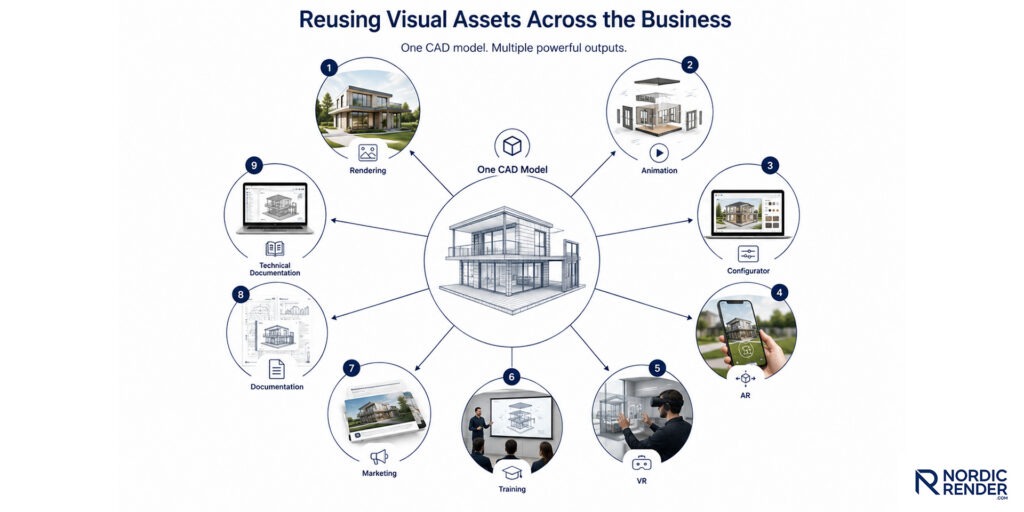
One of the greatest advantages of modern 3D visualisation is that a single digital asset can support different communication needs across multiple departments. The same 3D model used to create a product animation can often be reused for photorealistic renderings, interactive product configurators, augmented reality experiences, technical illustrations, installation guides, training materials and future marketing campaigns.
This approach improves consistency while reducing duplicated work. Instead of producing separate visual assets for every communication channel, organisations build a reusable visual foundation that evolves alongside their products. As digital product information becomes increasingly connected, the long-term value often lies not in a single animation, but in the underlying visual assets that continue supporting communication throughout the product lifecycle.
Looking Ahead: The Future of Business Animation
Animation continues to evolve alongside advances in real-time rendering, cloud technologies and interactive visualisation. Animations are increasingly combined with web-based product experiences, allowing users not only to watch products but also to interact with them. Real-time technologies make it possible to personalise content, visualise product variations instantly and integrate animations within broader digital ecosystems that include configurators, virtual showrooms and immersive experiences.
Artificial intelligence is also beginning to influence animation workflows by assisting with repetitive production tasks, content generation and localisation. While these technologies continue to develop rapidly, they are unlikely to replace the need for clear communication, accurate visualisation and thoughtful storytelling. Instead, they will enable businesses to produce high-quality visual content more efficiently and adapt it more easily for different audiences and communication channels.
The future of business animation is therefore unlikely to be defined by animation alone. It is becoming one component of connected digital experiences that combine rendering, interaction, real-time visualisation and intelligent technologies to communicate increasingly complex products and ideas.
Business Animation Within the Business Visualization Ecosystem
Business animation is most effective when viewed as part of a broader visual communication strategy rather than as a standalone deliverable. Different communication challenges require different visual approaches. Some situations call for a single image. Others require movement, interaction or immersive experiences. Together, these technologies form a connected ecosystem that helps organisations communicate more effectively throughout the customer journey.
Business visualisation brings these approaches together. Photorealistic renderings communicate appearance and design. Animation explains movement and processes. Interactive product experiences encourage exploration and comparison. Virtual tours create spatial understanding, while technical illustrations continue supporting detailed documentation and service.
The objective is not to use every technology available, but to select the combination that best supports understanding. As products, manufacturing processes and customer expectations continue to evolve, organisations that build flexible visual communication strategies will be better positioned to explain complexity, support better decisions and create stronger customer experiences. Together these approaches create connected digital experiences rather than isolated visual assets.
Conclusion
Business animation has become far more than a creative medium or marketing tool. It is an increasingly important method of communicating products, processes, spaces and ideas that cannot be fully explained through static media alone.
Research demonstrates that animation improves understanding of dynamic concepts, while modern businesses increasingly rely on visual communication to support sales, engineering, training and collaboration. Whether introducing a new product, explaining a manufacturing process or helping customers explore future projects, animation enables organisations to communicate information that would otherwise remain difficult to understand.
As technologies continue to evolve, the fundamental objective remains unchanged: helping audiences make informed decisions with greater clarity and confidence.
Viewed within the wider Business Visualization ecosystem, animation is not simply about creating movement on screen. It is about making complex information accessible, supporting better decisions and enabling organisations to communicate increasingly complex products, processes and ideas with greater clarity, consistency and confidence.
Frequently Asked Questions
When should a business use animation instead of static renderings?
It depends on what needs to be communicated. Photorealistic renderings are often the best choice for presenting design, materials and atmosphere. Animation becomes more valuable when the objective is to explain movement, functionality, assembly, manufacturing processes or changes over time. Many organisations use both, combining static images for visual presentation with animation for explanation.
Which industries benefit most from business animation?
Business animation is widely used across manufacturing, engineering, architecture, construction, real estate, healthcare, education and technology. Any organisation that needs to explain complex products, technical processes or future projects can benefit from using animation as part of its visual communication strategy.
Can business animation be used for technical documentation and training?
Yes. Many companies use animation to support installation guides, maintenance procedures, employee onboarding and customer training. Animation complements written documentation by showing how procedures are performed, making complex instructions easier to understand and remember.
Is business animation only for marketing?
No. While animation is widely used in marketing and product launches, it also supports engineering, sales, technical documentation, customer support, manufacturing, internal communication and education. Many organisations use the same animation throughout the product lifecycle for different audiences and purposes.
How does business animation work with interactive product configurators?
Animation and interactive configurators solve different communication challenges. Configurators allow users to explore product options, materials and configurations independently, while animation explains how products function, are assembled or operate. Many companies combine both to create richer digital product experiences.
Read more about product configurators here.
Can existing CAD models be used to create business animations?
In many cases, yes. Existing CAD models, BIM models or other 3D data can often be adapted for animation, interactive experiences and photorealistic visualisation. The amount of optimisation required depends on the quality and complexity of the original files, but reusing existing product data can significantly reduce production time and improve consistency across different visual assets.
How long does it take to produce a business animation?
Production time depends on the project’s complexity, the availability of 3D data and the intended level of detail. Smaller product demonstrations or installation animations can often be delivered within a few days, while more complex architectural or industrial projects involving multiple scenes, simulations or detailed storytelling may require several weeks. Reusable 3D assets also help streamline future updates, making new animations faster and more efficient to produce.
What is the difference between business animation and explainer videos?
Explainer videos often combine animation with narration, graphics and storytelling to introduce a product, service or concept. Business animation focuses primarily on visualising products, processes, spaces or technical information. While explainer videos are frequently marketing-oriented, business animation is also widely used for engineering, manufacturing, training, technical communication and customer support.
References
Aysolmaz, B., & Reijers, H. A. (2021). Animation as a dynamic visualization technique for improving process model comprehension. Information & Management, 58(5), Article 103478. https://doi.org/10.1016/j.im.2021.103478
Kleftodimos, A. (2024). Computer-Animated Videos in Education: A Comprehensive Review and Teacher Experiences from Animation Creation. Digital, 4(3), 613-647. https://doi.org/10.3390/digital4030031
Lindner, F., Reiner, G. & Keil, S. A behavioral perspective on visualization in manufacturing and operations management: a review, framework, and research agenda. Oper Manag Res 18, 317–352 (2025). https://doi.org/10.1007/s12063-024-00534-9
ResearchAndMarkets. (2025). Animation market report: Global industry trends, share, size, growth, opportunity and forecast. https://www.researchandmarkets.com/report/animation