
Communicating Products, Services and Brands Through Motion
Published on 10. Aug 2026

Kert Klementi
CEO & Founder | Business Visualization Strategist
Why Marketing Animation Works
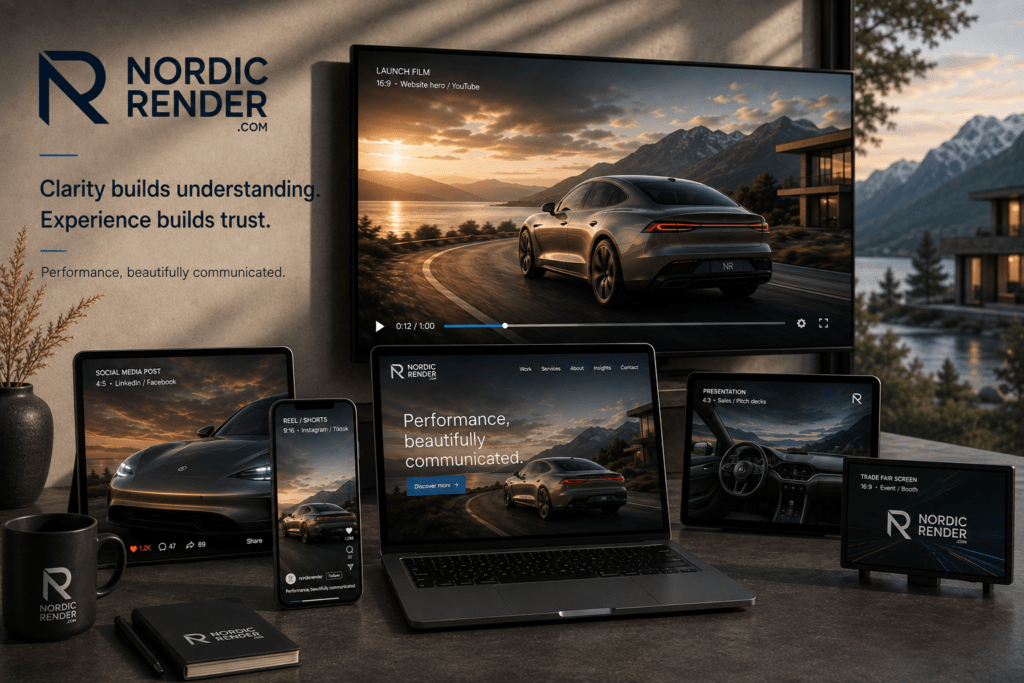
Marketing animation combines storytelling, purposeful motion and visual communication to explain ideas that static visuals cannot communicate alone. Whether introducing products, explaining services or presenting future spaces, it helps organisations attract attention, convey value and build confidence throughout the customer journey. The following principles explain why it has become such an effective business communication tool.
Marketing Is About Communicating Change
As discussed in our article on Business Animation, animation enables companies to communicate information that is difficult to express through static visuals alone. While business animation encompasses many applications—from technical documentation and training to architectural visualisation and product demonstrations—marketing animation focuses specifically on attracting attention, showing value and helping customers engage with products, services and brands throughout the marketing and sales journey.
Whether the subject is a physical product, a professional service, a manufacturing process, a future building, a digital platform or a complex business solution, marketing animation transforms information into experiences that audiences can see, follow and remember.
Marketing has always been about explaining the value of products, building connections with brands and giving people the confidence to take the next step. Companies introduce innovations, explain solutions, communicate value and encourage customers to act. While photography and static visuals remain essential marketing tools, they cannot always communicate information that unfolds over time or demonstrate experiences that customers need to see before making a decision.
In B2B marketing manufacturers often communicate technically sophisticated, configurable or highly customised products. Customers are not simply evaluating appearance—they are assessing functionality, value and whether a solution meets their specific requirements. Helping potential buyers evaluate these aspects is essential throughout the decision-making process.
Many of the things companies want to communicate involve movement. A product may need to demonstrate how it works. A service may consist of several connected steps. A manufacturing process may require a sequence of actions, while a new technology often becomes much clearer when customers can see it in operation rather than imagine it from text or diagrams. Marketing campaigns increasingly use animation to communicate how products are manufactured, tested, installed or delivered, helping customers appreciate the expertise, quality and processes behind the final product.
3D marketing animation adds time as another dimension of communication. Instead of presenting a single moment, it reveals transformation, interaction, sequence and progression, allowing organisations not only to explain ideas more clearly but also to create richer, more memorable customer experiences that strengthen understanding, build confidence and help with purchase decisions.
Rather than replacing photography or product visualisation, animation complements them by communicating what static visuals cannot while strengthening brand perception, customer engagement and more effective visual storytelling across the buying process.
Motion Should Support the Message
Modern marketing competes for attention across websites, various social media platforms, digital advertising, trade fairs and countless other channels. Simply adding movement, however, does not automatically make communication more effective.
Research has shown that different types of animated movement influence consumer responses in different ways. In a series of experiments, imagery appearing to move towards the viewer generated higher levels of psychological arousal and stronger purchase intentions than either static imagery or movement appearing to recede away. The findings also demonstrated that audience characteristics influence how motion is perceived, highlighting that the effectiveness of movement depends on how it is used rather than on movement alone (Fennell & Schneider, 2023).
For marketers, this means that successful animation is not defined by how much movement it contains but by how well that movement contributes to the intended message. Purposeful motion guides attention, reinforces key messages and creates stronger connections between customers and brands. Every transition, camera movement and product reveal should contribute to the overall marketing goal rather than serving as decoration.
Whether created as 3D animation, motion graphics or hybrid productions, every movement should support a marketing objective—building awareness, increasing engagement, strengthening brand recognition or encouraging customers to take the next step.
Marketing Animation Turns Information into Experiences
Marketing rarely succeeds by presenting facts alone. Whether communicating a product, a professional service, a manufacturing process, a future building or a complex business solution, people want to understand not only what something is, but how it creates value. They also want the confidence that comes from experiencing ideas, technologies and environments before making a decision.
Animation allows organisations to communicate these ideas through experiences rather than isolated images. Instead of showing a product from a single angle, animation can reveal how it functions, how components interact or how it transforms during use. Services can be visualised through customer interactions, manufacturing processes can unfold step by step, future spaces can be explored before they exist, and abstract technologies become easier to evaluate when viewers can follow them in context.
Beyond increasing clarity, animation also reduces uncertainty. Customers no longer need to imagine how something works or mentally reconstruct a sequence from separate images—they experience it directly. This combination of explanation, demonstration and visual storytelling builds confidence throughout the buying process while making business concepts easier to evaluate and remember.
For many organisations, this improved clarity has a direct commercial benefit. When customers can see how a product, service or technology works in context, they are better equipped to assess its relevance to their own requirements and move forward with greater confidence.
Storytelling Through Motion
Every successful marketing animation tells a story. That story may introduce a new product, explain an innovation, demonstrate expertise, strengthen a brand or guide customers from recognising a problem to understanding its solution. Unlike static visuals, animation unfolds over time, allowing information to be presented in a logical sequence and directing attention to the moments that matter most.
A systematic review published in the Journal of Advertising analysed 64 studies on visual storytelling and found that effective visual narratives establish context, focus attention on meaningful actions and create experiences that resonate with viewers. Together, these elements improve understanding, strengthen engagement and encourage behavioural responses such as product consideration and purchase intentions (Nikulina et al., 2024).
Marketing animation builds on these same storytelling principles while adding purposeful motion, timing and transitions that guide viewers naturally from one idea to the next. Rather than asking audiences to imagine how a product works, how a service is delivered or how a process unfolds, animation presents the story directly, making products, services and business concepts easier to evaluate, more memorable and often more emotionally engaging.
Marketing Animation for Different Business Objectives
Marketing animation is not limited to product promotion. Every organisation has different communication objectives, and the most effective animation is always designed around the message it needs to communicate rather than the medium itself.
Depending on the business objective, marketing animation can communicate:
- Products — launches, features, configurable options and premium product storytelling.
- Services — consulting, logistics, engineering, software, healthcare and financial services.
- Processes — manufacturing, sustainability initiatives, quality assurance and business workflows.
- Spaces — architecture, interiors, hospitality environments, workplaces and future developments.
- Technologies — innovations, research projects, digital platforms and industrial systems.
- Brands — identity, values, marketing campaigns, employer branding and corporate communication.
Although these applications differ significantly, they share the same objective: transforming complex information into engaging visual experiences that help audiences understand, evaluate and remember what matters most. Whether the goal is launching a new product, presenting a service, communicating an innovation, promoting a future development or strengthening a brand, successful marketing animation begins with a clear goal. Once that objective is defined, the storytelling, visual style and animation technique can be chosen to support it.
Start with the Communication Goal
Successful marketing animation begins with a business objective rather than a video format. Many companies start by asking whether they need a promotional video, a 3D animation, a product animation or a series of social media reels. In reality, these decisions come much later. The more important question is what the audience should understand, remember or do after watching the animation.
Is the goal to introduce a new product? Build brand recognition? Explain a complex service? Generate qualified enquiries? Help the sales team? Increase engagement? Each objective requires a different approach to storytelling, pacing and visual presentation.
By starting with the communication challenge instead of the deliverable, businesses create animations that contribute to measurable marketing outcomes rather than simply producing visually attractive content. The technology is important, but it should always serve the communication strategy rather than define it.
Launching Products and Explaining Innovations
One of the most common applications of marketing animation is introducing products that customers have never seen before. Whether launching an innovative technology, a configurable product or a completely new product range, organisations need to communicate more than appearance. Customers want to see how the product works, what problems it solves and why it differs from competing solutions before committing to a purchase.
3D marketing animation allows companies to reveal products progressively instead of presenting every feature at once. Product reveals, feature demonstrations, moving components, configurable options and internal mechanisms can all be combined into a coherent visual story that would be difficult to communicate through static imagery alone.
This approach is particularly valuable for manufacturers introducing technically advanced or highly configurable products. By helping customers understand functionality before speaking with a sales representative, animation reduces uncertainty and enables more informed buying decisions. For products that require a deeper focus on functionality and operation, Product Animation provides a more specialised approach to demonstrating features, mechanisms and real-world use.
Building Brand Recognition Through Motion
Strong brands are recognised not only by what they look like but also by how they communicate. Colours, typography and photography create visual identity, while animation introduces movement as another element of brand recognition. Logo animations, product reveals, transitions, website hero animations, motion graphics and campaign videos all contribute to a consistent motion language that customers begin to associate with the company.
When motion is used consistently across websites, various social media platforms, presentations, advertising and trade fairs, it strengthens familiarity and reinforces the overall brand experience. Customers may not consciously notice recurring animation styles, but they recognise the consistency they create.
For many organisations, particularly in B2B marketing, consistent visual communication builds credibility alongside recognition. When every customer touchpoint reflects the same quality, style and messaging, brands become easier to recognise and easier to trust. Marketing animation therefore contributes not only to individual campaigns but also to creating a consistent visual language that strengthens brand recognition, credibility and long-term customer relationships.
Explaining Services and Complex Business Ideas
Many companies do not sell physical products at all. Instead, they offer services, software, engineering expertise or technologies that are difficult to visualise. Marketing animation makes these intangible concepts easier to follow by showing how services are delivered, how information moves through a system and how different processes connect.
The same approach also helps corporate communication beyond customer-facing campaigns. Marketing animation is equally effective for communicating public initiatives, research programmes, sustainability projects and collaborative innovation, where the objective is to explain an idea, encourage participation or demonstrate impact rather than promote a single product.
Organisations increasingly use animation to introduce company strategies, communicate sustainability initiatives, present annual achievements, strengthen employer branding, support investor communication and explain organisational changes through engaging visual storytelling. Rather than relying on paragraphs of text or static diagrams, animation presents services, workflows and connected processes in a way that customers can follow naturally.
This approach is particularly valuable for companies selling expertise rather than physical products. By combining 3D animation, motion graphics and visual storytelling, companies can communicate abstract ideas in ways that are engaging, memorable and easier to understand.
Some communication challenges require much greater technical depth than a marketing animation typically provides. Installation procedures, assembly sequences, maintenance workflows and manufacturing processes often demand a more specialised approach where technical accuracy becomes the primary objective. These applications are explored in our guide to Technical Animation: Explaining Products, Processes and Installation.
Creating Marketing Content Across Multiple Channels
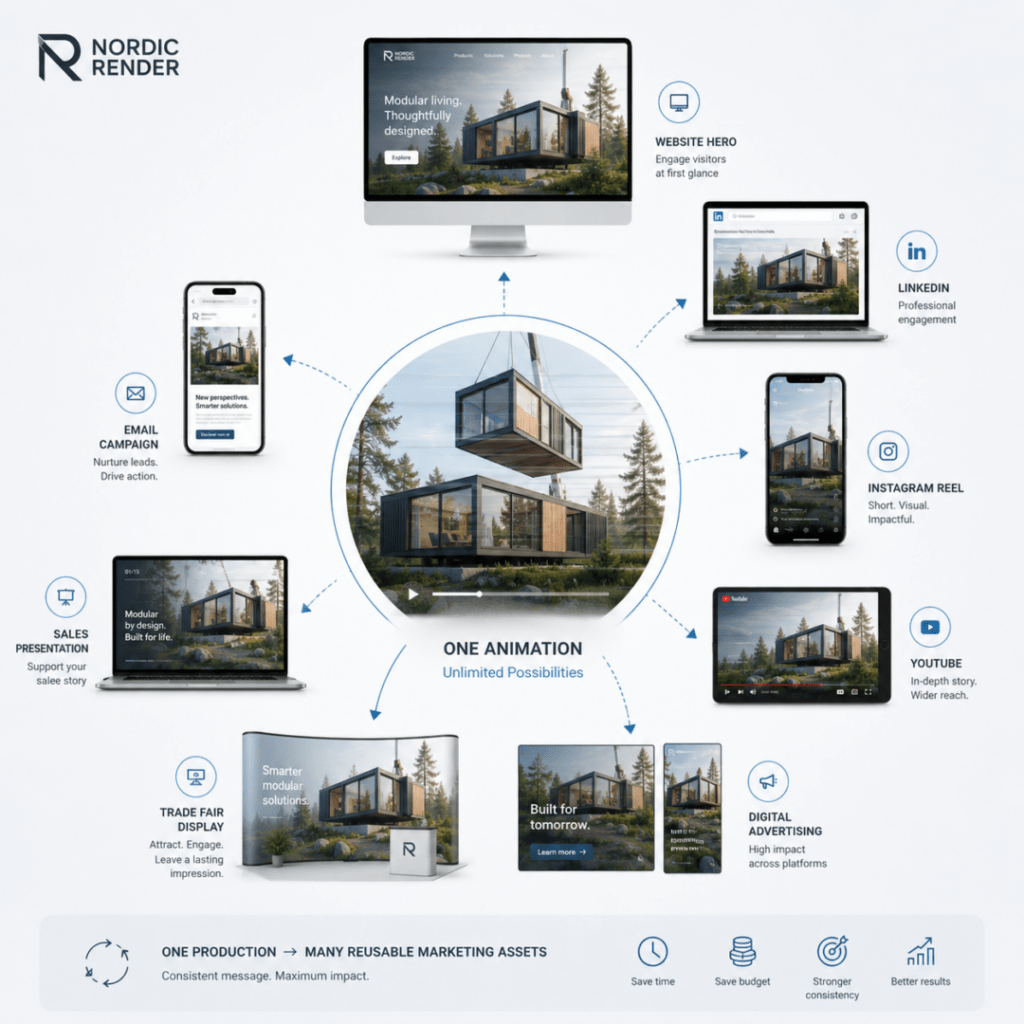
Modern marketing rarely takes place in a single channel. A product launch may appear simultaneously on a company website, LinkedIn, Instagram, YouTube or TikTok, in digital advertising, email campaigns, trade fair displays and sales presentations. Each environment, however, has its own format, pace and viewing context.
Marketing animation works particularly well across this landscape because the material can be adapted to suit different situations. A longer launch animation might provide the starting point for short social media clips, vertical reels, a website hero loop, digital advertising or selected sequences for exhibition screens. The central message and visual identity remain consistent, while the presentation is adjusted to how and where people encounter it.
A website hero animation, for example, has a very different task from a detailed product film. It has only a few seconds to establish an impression of the company, product or expertise and give visitors a reason to explore further. In digital advertising, the window for attention is even shorter, so the selected sequence needs to reach the central message or call to action quickly.
Trade fairs create another viewing situation altogether. Animation shown on a large LED wall or exhibition screen often needs to work without sound and capture the attention of someone passing by for only a few seconds. A strong opening shot, clearly presented product or well-chosen demonstration can draw visitors towards the stand and provide a natural starting point for conversation.
The same principle applies to social media, presentations and other marketing formats: the strongest result does not necessarily come from publishing an identical video everywhere, but from selecting and adapting the material to the requirements of each channel.
For this reason, the intended channels should already be considered during production planning. Knowing where the animation will ultimately appear makes it possible to plan scenes, framing, duration and alternative formats from the outset. One production can then provide the foundation for multiple channel-specific outputs without requiring every piece of marketing content to be created from scratch.
Supporting Sales Beyond the Marketing Campaign
Marketing animation can also play a practical role once a potential customer moves from initial interest into a sales conversation. Animations created for product launches or marketing campaigns give sales teams a shared visual reference for customer meetings, distributor presentations, trade fairs and online demonstrations. Instead of describing functionality, applications or key benefits entirely in words, sales representatives can show them directly and use the animation as a starting point for a more focused discussion.
This is particularly useful for technically sophisticated products and services. When potential buyers already have a basic understanding of how something works or where it can be applied, the conversation can move more quickly towards their specific requirements, available options and potential fit.
In this way, marketing animation becomes an effective sales enablement tool. The same professionally produced material can be used by different sales representatives, distributors and international teams, helping maintain a consistent product story while still allowing each conversation to respond to the individual customer.
It can also strengthen the connection between marketing and sales. A prospect who first encounters a product through a campaign may enter the sales process with greater familiarity, giving the sales team a stronger foundation on which to continue the conversation.
Marketing Animation Across the Customer Journey
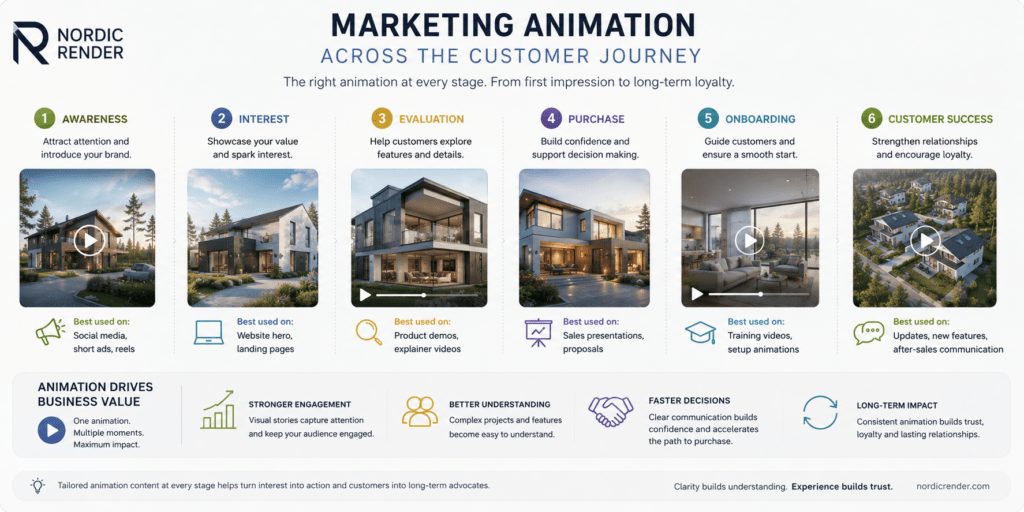
Marketing animation can play different roles across the customer journey—from creating initial interest and supporting product evaluation to strengthening sales conversations and continuing communication after purchase. The overview below illustrates how the role of animation changes as customers move through different stages of the journey.
Planning Successful Marketing Animation Projects
Successful marketing animation begins long before production starts. The greatest value comes from clear communication objectives, careful planning and designing content that can be reused across multiple marketing channels. The following recommendations explain how organisations can maximise the long-term value of every animation project.
One Production. Multiple Visual Communication Assets
One of the biggest misconceptions about marketing animation is that the finished video is the final deliverable.
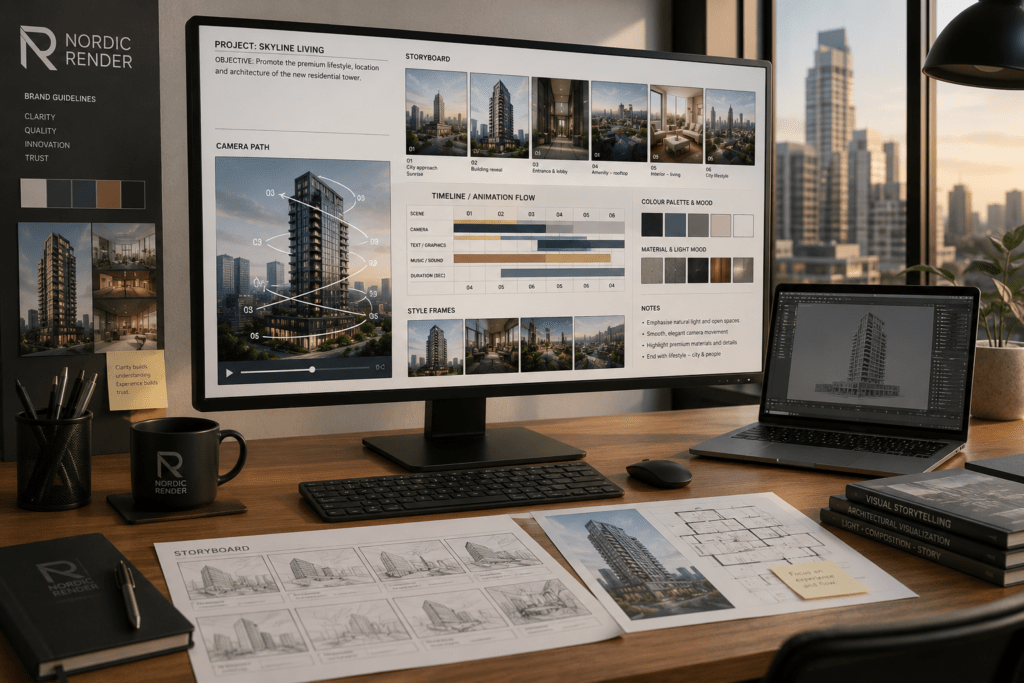
In reality, the animation is only one outcome of a much broader production process. When a project is planned strategically, individual scenes and sequences can become visual communication assets—reusable visual elements created for different audiences, channels and business purposes.
The complete animation might form the centrepiece of a product launch, website presentation or trade fair display. Individual elements can then take on different roles. A product demonstration might become a short social media reel; a feature sequence can be adapted for digital advertising or a sales presentation; installation scenes may be used in onboarding or technical documentation; and lifestyle environments or individual rendered frames can continue into websites, brochures and future campaigns.
This changes the way an animation project can be viewed. Instead of investing in one finished marketing video, an organisation can build a library of visual communication assets for marketing, sales, customer education, technical documentation and training. The production therefore creates not only a campaign deliverable, but a visual resource base that can serve different parts of the business.
The same foundation can also make future development more efficient. New product variants, updated messages, additional languages or market-specific versions can often build on existing scenes and 3D assets rather than requiring an entirely new production. Over time, this creates a scalable visual asset library that can evolve alongside the product portfolio and the organisation’s communication needs.
Choosing the Right Animation Format
Not every marketing objective requires the same type of animation. Some products benefit from highly realistic 3D product animations, while others are better communicated through motion graphics, live-action video combined with animation or short social media clips. Brand campaigns often focus on emotion and storytelling, whereas technical products usually require demonstrations that prioritise clarity and understanding.
The most successful projects begin by defining the business objective before selecting the production technique. The choice between 3D animation, motion graphics, product demonstrations or hybrid productions should always serve the message rather than becoming the objective itself.
Brands also benefit from recognising that different forms of animation often complement one another. A marketing animation may introduce a product, while a more detailed Product Animation demonstrates its functionality. Technical Animation can support installation and customer education, whereas Architectural Animation helps communicate future buildings and developments before construction begins. Together, these specialised approaches create a complete communication strategy rather than isolated pieces of content.
The Growing Role of AI in Marketing Animation
Artificial intelligence is rapidly changing how marketing content is planned, produced and distributed. AI-powered tools can assist with script generation, storyboarding, voiceovers, localisation, subtitles and adapting content into multiple formats for different audiences and marketing channels. These capabilities help organisations create campaign variations more efficiently while maintaining a consistent presence across digital platforms.
Rather than changing the purpose of marketing animation, AI complements existing production workflows by accelerating repetitive tasks and making high-quality visual content easier to adapt, personalise and distribute. This allows creative teams to focus more on communication strategy, visual storytelling, creative direction and producing engaging customer experiences.
As AI technology continues to evolve, marketing animation is likely to become increasingly adaptive, personalised and scalable. Companies that combine AI-assisted workflows with professionally produced visual content will be better positioned to create consistent brand experiences, support international marketing activities and communicate effectively across markets, channels and customer touchpoints.
Looking Ahead
Marketing communication continues to evolve as digital platforms and real-time technologies create new ways to present products and services. Real-time rendering makes it easier to personalise visual content and adapt animations for different audiences. Interactive experiences increasingly combine animation with product visualisation, allowing customers not only to watch products but also to explore them. As these technologies mature, the boundaries between animation, interactive experiences and immersive visualisation will continue to become less distinct.
The future of visual communication is also becoming increasingly connected. 3D animation, interactive experiences, AI-assisted content creation and real-time visualisation are no longer isolated technologies but complementary parts of a broader Business Visualization ecosystem. Together, they enable brands to communicate more effectively—from creating awareness and generating enquiries to strengthening sales, customer education and long-term relationships.
Businesses that invest in flexible, high-quality digital assets today will be better positioned to adapt their communication strategy as customer expectations, digital platforms and visual technologies continue to evolve.
Rather than replacing one another, animation, interactive experiences and immersive technologies are increasingly working together to create richer digital customer experiences throughout the entire business journey.
Conclusion
Marketing animation has become an important part of modern business communication because many marketing messages involve more than appearance alone. Products need to demonstrate functionality, services require context, manufacturing processes unfold over time, future spaces need to be experienced before they exist, and new technologies often become more tangible when shown in action.
Its business value can also extend well beyond the finished film. When production is planned with future applications in mind, individual scenes, sequences and 3D assets can continue serving marketing, sales, customer communication and other business functions. This makes animation not only a campaign format, but part of a broader visual foundation that organisations can develop and adapt over time.
Whether introducing a new product, strengthening brand recognition, generating demand or equipping sales teams with better communication tools, marketing animation combines motion, storytelling and strategic purpose to make products, services and ideas more engaging, memorable and easier to evaluate.
Within the broader Business Animation discipline, Marketing Animation works alongside Product Animation, Technical Animation and Architectural Animation, each addressing different communication needs. Together, they form an important part of Nordic Render’s Business Visualization approach—using the right visual medium to present products, services and business ideas with clarity and purpose across marketing, sales and customer communication.
Frequently Asked Questions
What is marketing animation?
Marketing animation uses motion to communicate products, services, brands and ideas in a way that static visuals cannot. It helps businesses attract attention, explain value, build trust and encourage customers to take the next step. Depending on the objective, marketing animation may introduce a new product, explain a service, strengthen brand recognition or support sales.
What types of marketing animation do businesses use?
Marketing animation includes a wide range of formats depending on the intended outcome. Common examples include product launch animations, product demonstrations, service explainers, process visualisations, architectural promotional films, website hero animations, social media reels, trade fair presentations, digital advertising, employer branding videos, animated logos and corporate communication campaigns. Many organisations combine several of these formats as part of a broader visual communication strategy.
Is marketing animation only suitable for consumer brands?
No. Marketing animation is equally valuable in B2B industries such as manufacturing, engineering, construction, architecture and technology. Complex products, technical solutions and configurable systems often benefit even more from animation because customers need to evaluate functionality, processes and business value before making purchasing decisions.
Can one marketing animation be used across multiple marketing channels?
Yes. A professionally planned animation can be adapted for company websites, social media, digital advertising, trade fairs, presentations, email campaigns and sales meetings. Individual scenes can also be repurposed into shorter videos, vertical reels, website hero animations and other marketing assets, allowing businesses to maximise the value of a single production.
What information is needed to create a marketing animation?
The required materials depend on the project. Product animations often begin with CAD models, 3D files or product photography, while service animations may rely on process descriptions, sketches or existing branding materials. Logos, brand guidelines, reference images and marketing objectives also help shape the final animation and ensure it aligns with the intended communication strategy.
How long should a marketing animation be?
There is no single ideal length. Website hero animations are often only a few seconds long and designed to loop continuously, while social media videos typically perform best between 15 and 60 seconds. Product launches, service explainers and promotional presentations may run for one to three minutes, depending on the complexity of the message and the intended audience. The most effective duration is determined by the strategic purpose rather than a fixed time limit.
Can marketing animation improve SEO and online visibility?
Animation can improve user engagement by encouraging visitors to spend more time exploring products and services, particularly when combined with relevant written content. Well-structured visual content also supports richer product communication across websites, social media and AI-powered search experiences. While animation alone does not improve search rankings, it can strengthen the overall effectiveness of a company’s digital marketing strategy.
How does marketing animation differ from product animation or technical animation?
Although these disciplines use similar production techniques, they serve different communication objectives. Marketing animation focuses on attracting attention, building brand recognition and communicating value. Product animation explains features, functionality and product benefits in greater detail, while technical animation supports assembly, installation, operation and maintenance. Together, these specialised approaches help businesses communicate effectively throughout the entire customer journey.
Read more in our guides to Technical Animation and Business Animation.
What are visual communication assets?
Marketing animations are only one type of visual communication asset. A visual communication asset is any reusable visual element created during the production process that continues supporting business communication over time. These may include complete animations, product demonstrations, social media clips, website hero videos, still renders, technical sequences, training content, presentation visuals and campaign assets. By planning projects strategically, organisations can build a library of visual communication assets that supports marketing, sales, customer education and technical communication long after the original production has been completed.
References
Fennell, P. B., & Schneider, G. (2023). The influence of visually dynamic imagery on purchase intentions: The roles of arousal and lay rationalism. Journal of Retailing and Consumer Services, 75, 103537. https://doi.org/10.1016/j.jretconser.2023.103537
Nikulina, O., van Riel, A. C. R., Lemmink, J., Grewal, D., & Verlegh, P. W. J. (2024). Narrate, act, and resonate to tell a visual story: A systematic review of how images transport viewers. Journal of Advertising, 53(1), 1–21. https://doi.org/10.1080/00913367.2024.2309921