
Published on 2. Dec 2025

This article offers marketers, architects, and product companies a clear framework for using visual communication strategically — combining scientific research with practical expertise developed through our work at Nordic Render across many industries. After more than twelve years of creating 3D visuals for architecture, real estate, and industrial products for marketing teams across Europe and the United States, we have learned that visuals consistently serve two equally important purposes:
- First, they communicate emotion when the goal is to inspire, persuade, or influence a purchase decision.
- Second, they provide clarity when the objective is to explain technical features, materials, or product functionality accurately.
Both roles are essential, and both have their place.
However, when the focus shifts to marketing, brand storytelling, and consumer decision-making, a consistent pattern emerges: emotion is one of the most powerful drivers of human choice. This insight is not merely a creative intuition from our professional practice, but one that is strongly supported by decades of research in psychology, neuroscience, and consumer behavior.
Neuromarketing Confirms What We See in Practice
Neuromarketing research shows that emotional responses play a central role in purchase-related decision-making, often shaping perception and evaluation before deliberate, rational reasoning begins (Pluta-Olearnik & Szulga, 2022). Rather than replacing logic, emotions guide attention, influence interpretation, and frame how information is processed. Supporting this view, Research Metric synthesizes findings from consumer psychology suggesting that up to 95% of purchasing decisions are influenced by emotional and subconscious processes (Research Metric, 2025).
Why Emotional Needs Drive Choices
Applied research further demonstrates how these mechanisms appear in real consumer behavior. Research summarized by Beall (2023) shows that purchase decisions are often guided more by emotional needs than by functional product features. Across two applied studies, emotional drivers such as belonging, reassurance, and aspiration proved more influential than purely rational considerations when shaping preference and choice.
The findings also suggest that emotional reactions are better indicators of purchase intent than purely informational or feature-focused messaging. In other words, people respond more strongly to how a product or brand makes them feel than to what it technically offers.
From Research to Practice
Together, these insights reflect what we consistently observe in real-world marketing projects at Nordic Render. The moment a viewer feels something — curiosity, comfort, aspiration, or desire — engagement deepens. Visuals are no longer just seen; they are experienced. At this stage, decisions start to take shape intuitively, long before features, specifications, or prices are consciously compared.
Why This Matters — and How It Applies to Technical Visualization
I do not mean to say that every 3D visual must be emotional. Far from it. In many industries — manufacturing, engineering, furniture design, and industrial components — technical precision is the priority. In these contexts, the success of a visual is measured by clarity, accuracy, and the faithful representation of product features.
However, when the goal shifts toward marketing, persuasion, differentiation, or brand experience, emotion becomes a crucial tool. At this stage, visuals are no longer just explanatory; they become interpretive, shaping how a product or space is perceived and remembered.
In practice, the most effective visual strategies combine both approaches:
- Technical 3D visuals to communicate function
- Emotional 3D visuals to communicate desire
This balance allows companies to show not only how a product works, but also why it matters.
At Nordic Render, this dual perspective is at the core of our work. With experience spanning highly technical product visualization and emotionally driven architectural and lifestyle imagery, we help companies choose the right visual language for each stage of communication — ensuring that precision and emotion work together to support clear understanding, stronger engagement, and confident decision-making.
How Visuals Create Emotion — The Core Mechanisms Marketers Should Know
Understanding why visuals work is essential for using them strategically. Over many years of producing thousands of 3D images and animations — from emotional lifestyle scenes to strict technical product renders — I’ve seen how specific visual elements consistently shape the viewer’s emotional response. Scientific research supports these observations.
Research by Shagyrov & Shamoi (2022) shows that colour palettes evoke predictable emotional associations: warm tones communicate energy or comfort, while cooler tones signal calmness, trust, and stability. These findings align with broader visual-perception studies indicating that lighting, composition, and spatial rhythm guide attention and shape emotional meaning. Soft lighting can create a sense of homeliness, while stronger contrasts introduce sophistication or intensity. When these foundations are combined with immersive or interactive elements — such as rotating a product model or navigating a virtual environment — emotional involvement and decision confidence increase significantly, as digital consumer-behaviour research consistently demonstrates. Together, these principles explain why carefully crafted visuals are powerful emotional and strategic tools in modern marketing.


Why 3D Delivers What Producers, Marketers, and Real Estate Professionals Need
Once we understand how strongly visuals influence emotion, the next question becomes inevitable:
Which visual approach communicates emotion — and clarity — most effectively?
Based on industry experience, observed client behaviour, and the research discussed so far, 3D consistently delivers the strongest results in contexts where emotional engagement, understanding, and decision confidence matter.
This is not because 3D replaces other visual formats, but because it enables something they cannot: the ability to create and communicate a realistic future state before anything is built or produced.
1. Realism + Imagination: The Emotional Bridge
3D visuals allow architecture, interiors, and products to be experienced as if they already existed — and often in ways that go beyond what photography can capture. While photography documents reality, 3D visualization constructs it, making it possible to present spaces, products, and lifestyles that are still only concepts.
This enables future buyers or users to imagine ownership early in the process, creating an emotional connection before construction, manufacturing, or physical staging begins. By making the intangible tangible, 3D shortens the psychological distance between interest and commitment.

2. Exploration, Motion, and Interaction (When Needed)
3D also offers the flexibility to move beyond a single viewpoint. Depending on the communication goal, this can include:
- Guided camera paths or animations
- 360° product turntables
- Interactive configurators
- Virtual walkthroughs
These options allow audiences to explore a product or space more naturally, supporting understanding and engagement. Importantly, even when delivered as a single, static image, 3D still benefits from this underlying spatial intelligence — because it is designed, not captured.
3. Lighting, Materials, and Atmosphere by Design
In 3D, every visual variable can be shaped with intention:
- Texture and material detail
- Reflections and shadow behaviour
- Natural versus artificial lighting
- Season, weather, or time of day
While colour theory explains emotional cues, full atmospheric control amplifies them. This is where 3D moves beyond representation and becomes a strategic communication tool, allowing brands to define not only how something looks, but how it is meant to feel.


4. Evidence from Real Estate Practice
In property marketing, buyers must understand elements such as:
- Volume and proportions
- Materiality
- Light and atmosphere
- Spatial flow
- Lifestyle potential
These qualities are fundamentally experiential. In our experience at Nordic Render, clients consistently report that 3D visuals help buyers better understand the lived experience of a space, leading to clearer expectations, more confident inquiries, and faster decision-making.
This practical feedback closely mirrors what both neuroscience and applied marketing research suggest: when people can see themselves in a space, decisions become easier.
Summary: Why 3D Is Indispensable for Emotional Communication
When the objective is emotional engagement, immersive storytelling, clear spatial understanding, and faster decision-making, 3D proves to be the most effective visual approach.
Across still visuals, lifestyle scenes, and animations, 3D enables audiences to experience light, materiality, atmosphere, and use before anything is built or produced. This ability to design and communicate a believable future state allows marketers, developers, and product companies to create desire, trust, and narrative — not just explain features.
In this context, 3D is not simply a visualization method; it becomes a strategic communication tool that connects imagination with decision.
Nordic Render: Expertise & Partnership
For more than twelve years, Nordic Render has provided expert 3D visualization services for real estate developers, product manufacturers, architects, and marketing agencies across Europe and the United States. Over this time, we have learned that effective visualisation requires more than technical skill — it requires a deep understanding of how people feel when they see a space or a product.
Our approach combines three pillars:
- Technical precision — accurate modelling, material realism, lighting control, and composition
- Narrative thinking — atmosphere, emotional cues, and visual storytelling that communicates purpose
- Proven marketing performance — repeated success in real-estate launches, product campaigns, and branding initiatives
This combination allows us to act not only as visual producers, but as strategic partners in our clients’ marketing and communication processes.
Every collaboration begins with a simple but essential question:
What emotion should this visual evoke?
Once that is defined, technical and artistic decisions follow naturally — guided by experience, informed by research, and shaped by a clear understanding of the project’s commercial and communicative goals.
Nordic Render Case Studies
Case Study 1: Product Visualization — From Single Object to Complete Context
Context
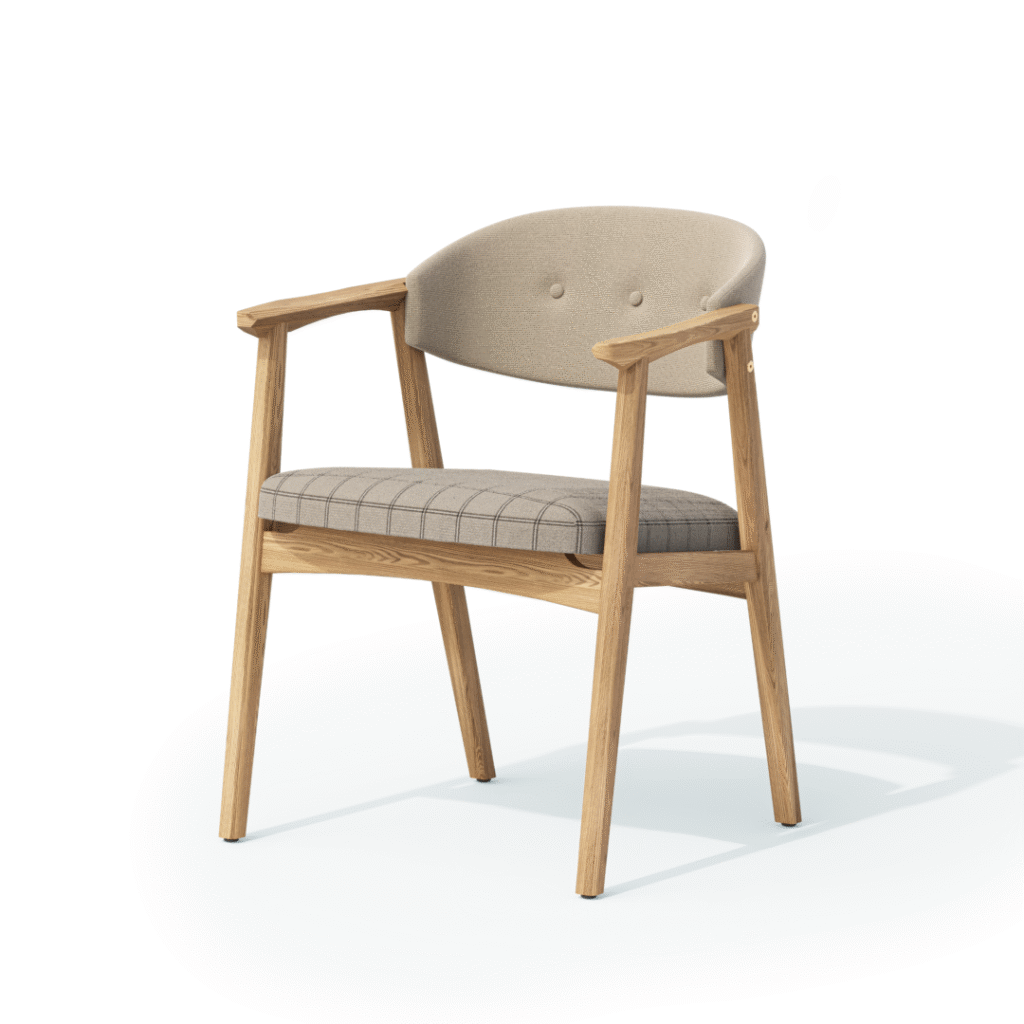
A Norwegian furniture manufacturer Helland Møbler needed to present a simple product — a wooden chair — for marketing and sales purposes. While photography was an option, producing multiple lifestyle images would have required physical sets, styled interiors, repeated photoshoots, and significant time and cost.
Challenge
The key challenge was not documenting the chair itself, but helping customers understand:
- how the chair fits into different interior styles
- how materials, textures, and proportions feel in context
- how the product supports a lifestyle, not just a function
At the same time, the visuals needed to remain flexible for catalogues, online use, and future variations.
Solution
Nordic Render created a detailed 3D model of the chair, carefully reproducing:
- wood grain and material character
- textile texture and stitching
- proportions, ergonomics, and construction details
Based on the client’s style direction and brand positioning, we then designed a complete interior scene that shows the chair in use — placed naturally within a warm, contemporary dining environment. This allowed the product to be presented both:
- as a clean, isolated visual for catalogues and e-commerce, and
- as a lifestyle scene that communicates mood, scale, and interior compatibility
All visuals were created without the need for physical prototypes, studio setups, or location shoots.

Result
The 3D visuals enabled the client to:
- showcase the same product across multiple marketing channels
- communicate material quality and craftsmanship clearly
- demonstrate how the chair fits into real living spaces
This approach reduced production complexity while increasing the visual impact and clarity of the product presentation.
Key Insight
Even for a simple product, 3D visualization allows brands to move beyond documentation. By designing context, materiality, and atmosphere intentionally, a single object can be transformed into a complete story — helping customers understand not only what the product is, but where it belongs and how it will feel in everyday use.
Case Study 2: Wooden Structures in Lifestyle Contexts — Versatile Living in Nature
Context
An Australian client Scandi Cabins offering compact wooden structures wanted to present their designs not only as functional garden buildings, but as flexible living spaces that adapt to modern lifestyles — from garden studios and guest houses to compact family homes.
Challenge
The challenge was to communicate versatility and emotional appeal at the same time. While the structures themselves are simple and efficient, potential buyers needed to see how they could become warm, comfortable, and inviting spaces within their own gardens and landscapes — not just standalone objects.
Solution
Nordic Render created a series of 3D lifestyle visuals placing the wooden structures into realistic garden environments typical of the Australian setting. Each scene was designed to highlight a different use case:
- a cozy garden living space connected to outdoor seating
- a compact family home integrated into lush surroundings
- a calm retreat that feels open, light, and connected to nature
Through careful control of lighting, materials, vegetation, and scale, the visuals emphasize warmth, natural textures, and everyday livability — showing how a simple wooden structure can become a meaningful part of daily life.


Result
The lifestyle-focused visuals helped potential buyers immediately understand how the structures could be used and adapted. Instead of asking technical questions first, conversations shifted toward use, comfort, and placement — supporting stronger engagement and clearer intent across marketing and sales channels.
Key Insight
When wooden structures are shown in context, they stop feeling like products and start feeling like places. By visualizing how these buildings fit naturally into real gardens and lifestyles, 3D storytelling transforms simple architecture into an emotionally compelling living solution.
Case Study 3: Real Estate 3D Animation — Turning Visuals into Motion
Context
An Estonian housing and architecture company Bigs H&H wanted to market a residential family-home project to buyers seeking comfort, atmosphere, and quality of life. Beyond still visuals, the client needed a format that could quickly capture attention and communicate emotion across modern digital marketing channels.
Challenge
The challenge was to translate architectural quality and interior atmosphere into a format suitable for modern marketing — particularly social media, websites, and digital campaigns — where movement, pacing, and storytelling play a decisive role.
Solution
Nordic Render created a cinematic 3D animation based on the project’s visual concept. Through smooth camera movement, carefully timed transitions, and warm, natural lighting, the animation guides the viewer from exterior to interior, connecting spaces into a coherent visual narrative.
Rather than focusing on technical detail, the animation emphasizes mood, flow, and everyday livability — making it easy for viewers to intuitively understand the home within a short viewing time.
Result
The animation proved highly effective as a marketing asset, especially in digital and social media contexts. Compared to static formats alone, it generated stronger engagement and more emotionally driven responses, helping the project stand out and attract more qualified interest early in the buyer journey.
Key Insight
3D animation transforms visual material into a story. By adding motion and rhythm, it turns architecture into an experience that is easy to consume, easy to remember, and well suited to modern marketing channels — strengthening emotional connection and buyer confidence.
Conclusion: From Emotion to Decision
Across psychology, neuroscience, and applied marketing research, one insight remains consistent: emotion is not a secondary effect in decision-making — it is foundational. Long before rational evaluation begins, people respond to atmosphere, tone, familiarity, and meaning. These emotional responses shape how information is interpreted, remembered, and ultimately acted upon.
Visual communication operates precisely at this level. Through colour, light, composition, materiality, and spatial context, visuals frame perception and guide emotional response. When these elements are designed intentionally, they do more than illustrate products or spaces — they help people imagine futures, form preferences, and make decisions with confidence.
This is where 3D visualization becomes especially powerful. By enabling brands to construct realistic future states before anything is built or produced, 3D shortens the distance between intention and commitment. Whether expressed through still images, lifestyle scenes, or animation, it allows audiences to experience how something will feel, not just how it will function.
In practice, the most effective visual strategies balance precision and emotion. Technical clarity builds trust; emotional resonance creates desire. When these work together, visuals become strategic tools rather than decorative assets.
At Nordic Render, this understanding guides our work across architecture, real estate, and product marketing — helping companies choose the right visual language for each stage of communication and support clearer, more confident decision-making.
Expert Q&A
How do you ensure emotional alignment in your visuals?
Every project begins with an emotional brief. We define the feeling the viewer should take away — whether it’s comfort, aspiration, trust, or clarity — and translate that into lighting, materials, composition, and atmosphere. Once the emotional goal is clear, all visual decisions become much more intentional.
Why is lighting so important in 3D visualization?
Lighting is one of the strongest emotional signals in visual communication. It shapes mood, depth, and atmosphere. Warm, soft lighting can convey comfort and familiarity, while cooler or more directional light often communicates precision, clarity, or sophistication.
How do you translate a client’s brand identity into 3D visuals?
We focus on a brand’s emotional character rather than just its visual guidelines. By understanding values, tone, and target audience, we express brand identity through material choices, colour balance, textures, and overall scene mood — ensuring the visuals feel consistent with the brand, not generic.
What role does storytelling play in your work?
Storytelling turns visuals from static representations into experiences. By creating a sense of sequence, context, or everyday use, we help viewers imagine themselves within a space or product environment. This makes the visual easier to remember and emotionally more engaging.
How do you know when a visual has done its job?
We look primarily at client feedback and long-term collaboration patterns. When clients return for new projects, reuse visuals across campaigns, or tell us that visuals helped them communicate more clearly with their customers, that is a strong indicator that the work is effective.
How do you balance realism and aspiration?
Trust comes from accuracy, while desire comes from atmosphere. We ensure that proportions, materials, and structure are realistic, while using lighting, composition, and context to introduce aspiration — creating visuals that feel both believable and emotionally compelling.
What does a long-term collaboration with Nordic Render look like?
Over time, many partners integrate Nordic Render into their marketing workflow. This leads to visual consistency, faster project turnaround, and a shared understanding of brand language — allowing each new project to build naturally on the last.
Sources
Beall, A. (2023, September 22). The power of emotional needs in consumer purchases: Insights from two studies. GreenBook. https://www.greenbook.org/insights/research-methodologies/the-power-of-emotional-needs-in-consumer-purchases-insights-from-two-studies
Pluta-Olearnik, M., & Szulga, P. (2022). The importance of emotions in consumer purchase decisions — A neuromarketing approach. Marketing of Scientific and Research Organizations, 44(2), 87–104. https://doi.org/10.2478/minib-2022-0010
Research Metric. (2025, August 19). Consumer psychology: Why 95% of buying decisions are emotional. https://www.researchandmetric.com/blog/consumer-psychology-buying-decisions-emotional-factors/
Shagyrov, M., & Shamoi, P. (2024). Color and sentiment: A study of emotion-based color palettes in marketing (arXiv:2407.16064). arXiv. https://doi.org/10.48550/arXiv.2407.16064