
Helping customers understand configurable furniture before they buy
Published on 14. Jul 2026

Kert Klementi
CEO & Founder | Business Visualization Strategist
Introduction
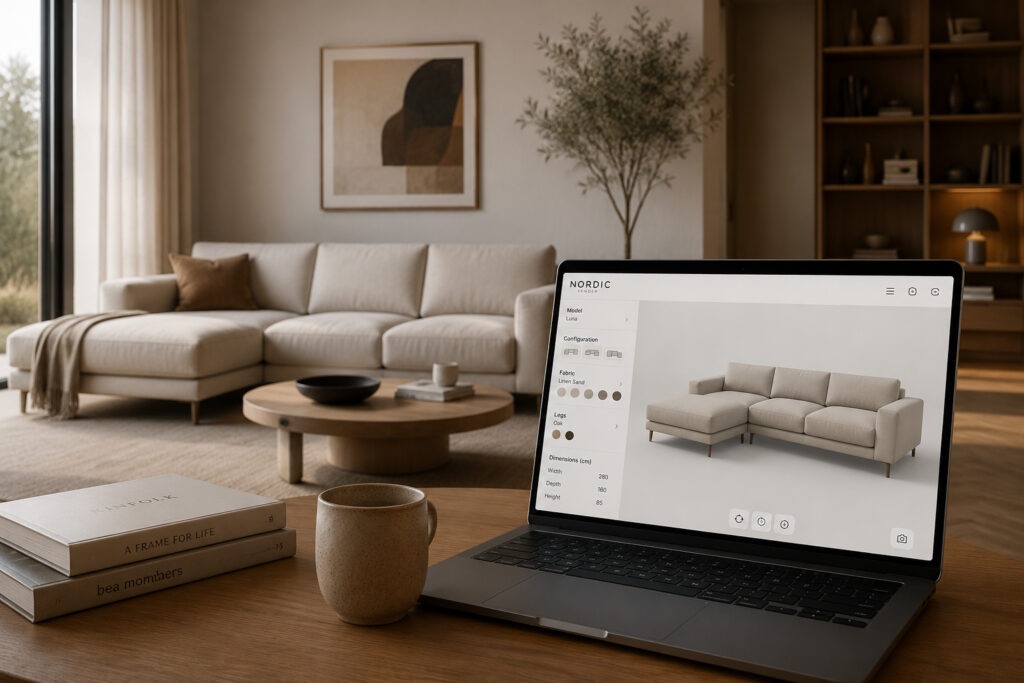
The furniture industry has become increasingly configurable. Manufacturers compete through modular systems, made-to-order production, extensive material libraries and highly differentiated collections, giving customers more choice than ever before. While this flexibility creates significant value, it also makes products considerably more challenging to communicate throughout the customer journey.
Traditional product photography, printed catalogues and physical showrooms remain essential sales and marketing tools, but they can present only a limited number of possible variations. Customers, dealers and architects increasingly need to understand how different dimensions, materials, finishes and modular components influence the final solution before making a purchasing decision.
Furniture product configurators address this challenge by transforming complex product portfolios into intuitive digital experiences. Instead of presenting every possible variation separately, configurators guide users through available options while visualising changes in real time. This enables manufacturers to communicate extensive collections more efficiently across websites, dealer networks, showrooms and digital sales presentations.
The growing importance of digital product communication reflects the scale and complexity of the furniture industry itself. According to the European Furniture Industries Confederation (EFIC), the European furniture industry generates more than €100 billion in annual turnover and is recognised globally for its design expertise, manufacturing quality and innovation (EFIC, 2024). As manufacturers continue to expand modular and customisable product portfolios, helping customers understand increasingly complex collections has become a strategic business priority rather than simply a marketing improvement.
What Is a Furniture Product Configurator?
A furniture product configurator is an interactive digital application that enables customers, dealers or sales teams to configure furniture by selecting predefined options such as dimensions, materials, colours, modules or accessories while immediately visualising the result.
The functionality depends entirely on the product itself. Some configurators focus on comparing materials and finishes, while others allow users to assemble modular furniture systems, define dimensions, generate quotations or prepare product specifications. More advanced solutions can also integrate pricing, product information, dealer enquiries or manufacturing data, becoming an integral part of the company’s digital sales process.
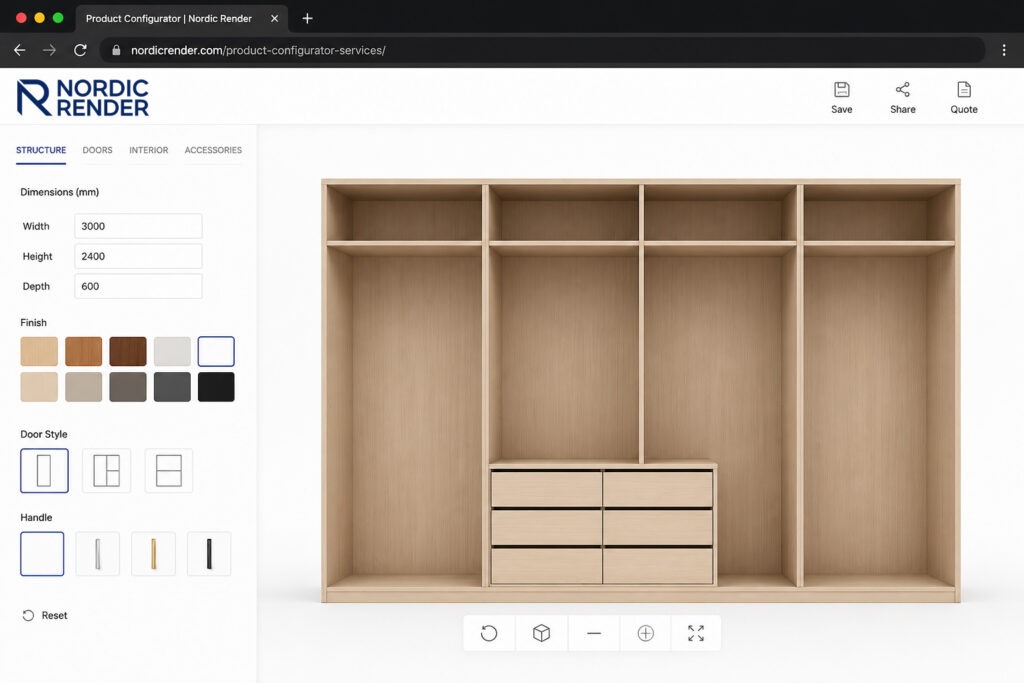
The objective is not simply to create an engaging interactive experience. A well-designed configurator simplifies product complexity by presenting available choices in a logical sequence and guiding users towards valid product combinations with confidence. Rather than replacing traditional photography or physical showrooms, it complements them by helping customers understand configurable products before contacting a dealer or placing an order.
While this article focuses on furniture applications, interactive configurators are increasingly used across many industries, including construction products, industrial equipment, windows and doors, modular building systems and consumer goods. If you would like to explore how configurators support manufacturing beyond the furniture industry, read our guide Product Configurators.
Industry Insights: Digital Transformation in the Furniture Industry
The furniture industry is evolving in response to changing customer expectations, increasing product complexity and growing international competition. Manufacturers are expanding modular and customisable product collections, investing in digital product communication and searching for new ways to present increasingly sophisticated collections more effectively throughout the customer journey.
The EFIC describes the sector as creative, versatile and highly innovative, with European manufacturers recognised worldwide for their design expertise and manufacturing quality. At the same time, the industry faces rising competitive pressure, changing sustainability requirements, fluctuating material costs and ongoing labour shortages, making efficiency, product differentiation and customer communication more important than ever (EFIC, 2024).
Market developments point in the same direction. According to CSIL analysis of the European upholstered furniture market, e-commerce has continued to expand across Europe, direct-to-consumer brands have gained visibility, and modular seating systems represent the fastest-growing product format (CSIL, 2025). Together, these developments suggest that manufacturers increasingly need effective ways to present configurable products and guide customers through available options.
Customer expectations are evolving alongside these market developments. The Home Furnishings Association reports that today’s furniture buyers increasingly expect to research and explore products digitally before visiting a showroom, while personalisation has become an expected part of the purchasing journey rather than a premium feature. As online and physical retail continue to converge, manufacturers are investing in richer digital experiences that help customers compare products, understand available options and make more confident purchasing decisions (Home Furnishings Association, 2025).
These developments create new opportunities for specialised and medium-sized manufacturers. Competing with global brands through extensive marketing budgets or large showroom networks is rarely realistic. Instead, many companies differentiate themselves through craftsmanship, product quality, distinctive design, specialist expertise and the ability to respond to specific customer needs. As product portfolios become more configurable and customer journeys increasingly begin online, communicating these strengths clearly becomes just as important as the products themselves.
Interactive product configurators support this shift by making complex furniture collections easier to understand. Rather than replacing the qualities that make a manufacturer unique, they help communicate them more effectively. Customers can explore configurable options, compare materials and better appreciate the design, functionality and craftsmanship behind each collection before speaking with a dealer or making a purchasing decision.
Why Interactive Product Configuration Matters
Furniture purchases often represent a significant financial investment and are expected to remain in use for many years. At the same time, buying behaviour continues to evolve. According to NielsenIQ, e-commerce continues to reshape the furniture market as consumers increasingly research and compare products online before making purchasing decisions (NielsenIQ, 2024). As furniture collections become increasingly modular and customisable, manufacturers need effective ways to help customers understand materials, finishes and product variations before they commit to a purchase.
Whether configuring a modular sofa, a fitted wardrobe, office furniture or a complete kitchen, customers want confidence that the selected solution will meet both their functional requirements and aesthetic expectations. Traditional catalogues and product photography remain important, but they can present only a limited number of predefined variations. Interactive configurators bridge this gap by allowing customers to actively explore different options and immediately see how each decision influences the final product.
A well-designed configurator does more than display product options. It guides users through available choices in a logical sequence, helping them understand complex product ranges without becoming overwhelmed. Academic research on product customisation suggests that while customers value personalisation, presenting too many configurable options without appropriate guidance can increase decision complexity and reduce purchase likelihood (Bambauer-Sachse, 2025). Effective configurators therefore simplify the decision-making process by presenting relevant options in a clear and structured way.
For manufacturers, this translates into tangible business benefits. Customers who better understand configurable products often approach dealers with clearer expectations, resulting in more productive sales conversations, fewer specification errors and greater confidence throughout the purchasing process. Configurators therefore support not only marketing, but also dealer communication, sales and customer service.
Ultimately, interactive product configuration is not about replacing personal advice or the showroom experience. It complements both by helping customers understand increasingly sophisticated furniture collections before they engage with a sales representative, creating a smoother and more informed buying journey.
Photography-Based and GLB-Based Furniture Configurators
Furniture configurators can be developed using different visual technologies, each suited to different products, customer journeys and business objectives.
A photography-based configurator presents predefined product images that change according to the customer’s selections. This approach is particularly effective when products are viewed from fixed angles and the primary objective is to compare colours, fabrics, wood finishes or other surface materials while maintaining complete photographic realism.
A GLB-based configurator, by contrast, uses interactive 3D models that run directly in a web browser. Customers can rotate products freely, zoom into details and explore configurable elements from any angle while switching materials, dimensions or components in real time. Because all variations are generated from a single optimised 3D model, manufacturers can present extensive product ranges without producing thousands of individual images.
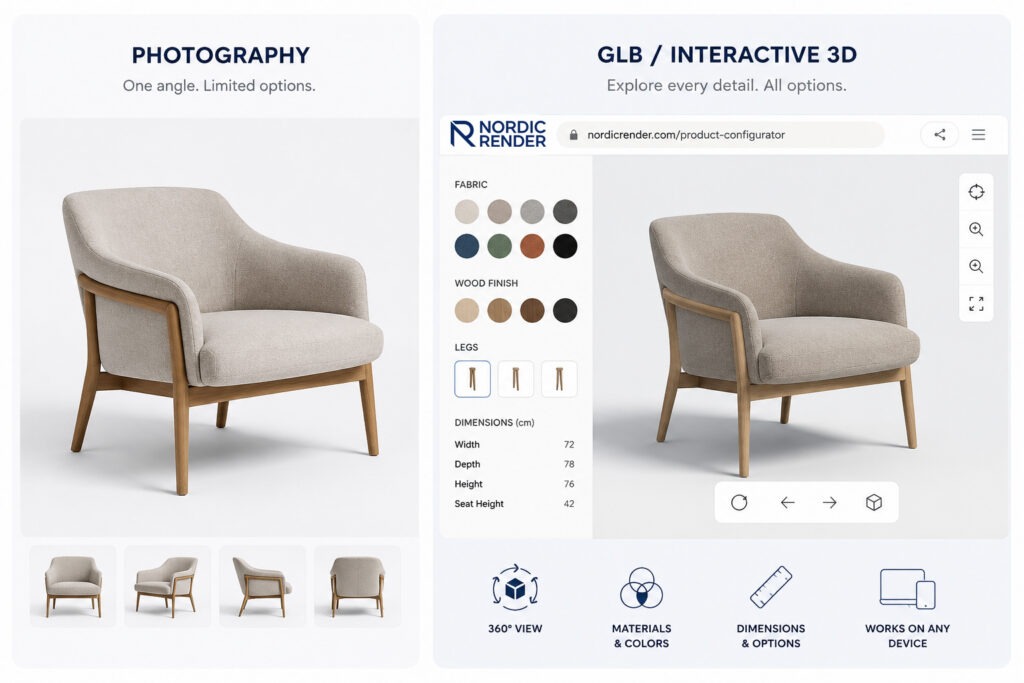
Neither approach is inherently better. Photography-based configurators remain an excellent solution for many furniture collections where the number of product variations is relatively limited and maintaining consistent photographic quality is the highest priority.
GLB-based configurators become particularly valuable for modular furniture systems, configurable storage solutions, office furniture, kitchens and other product families where customers benefit from exploring products interactively and understanding how different components work together.
Many manufacturers ultimately combine both technologies within their digital product strategy, using photography for marketing campaigns and catalogue imagery while introducing interactive 3D configurators to support product exploration, dealer communication and online sales.
If you would like to learn more about the technology behind interactive web-based configurators, including how GLB models are created, optimised and integrated into modern digital product experiences, explore our guide GLB Configurator for Manufacturers.
Business Benefits for Furniture Manufacturers
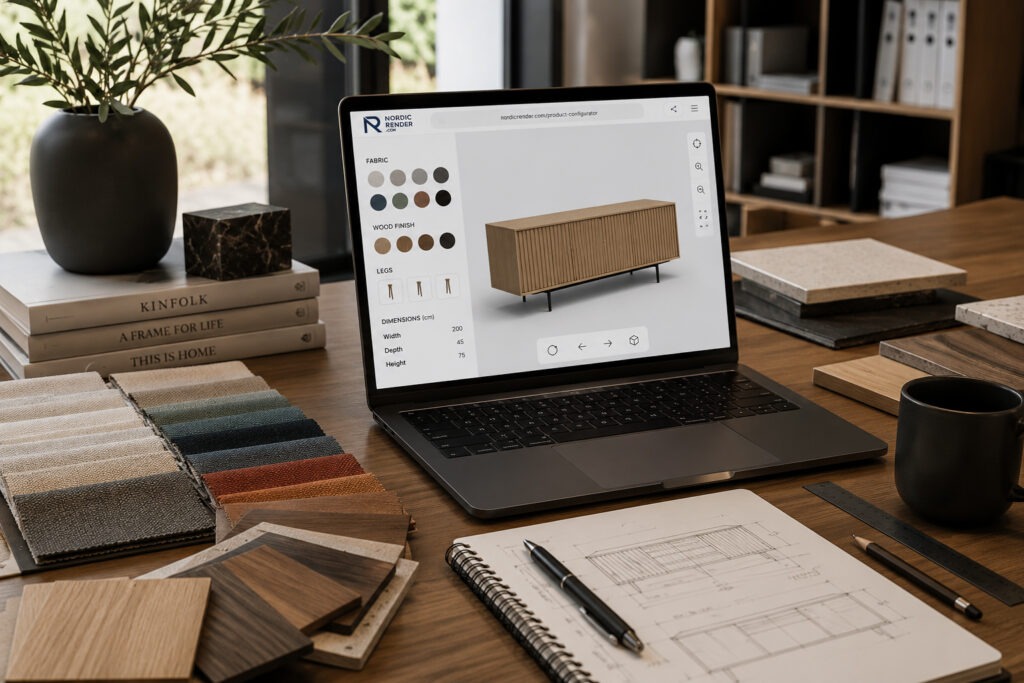
Interactive furniture configurators are far more than an engaging website feature. They improve product communication throughout the customer journey while supporting marketing, sales, dealer networks and customer service.
For furniture manufacturers, the most significant benefits include:
- Helping customers understand configurable collections more quickly and confidently.
- Presenting extensive material libraries and modular systems without overwhelming users.
- Supporting more productive discussions between customers, dealers and sales teams.
- Reducing misunderstandings during quotation, specification and ordering.
- Creating a consistent digital product experience across websites, showrooms and international markets.
Rather than replacing catalogues, product photography or physical showrooms, configurators complement existing sales and marketing materials by making increasingly complex furniture collections easier to explore and understand.
Furniture Product Configurators by Nordic Render
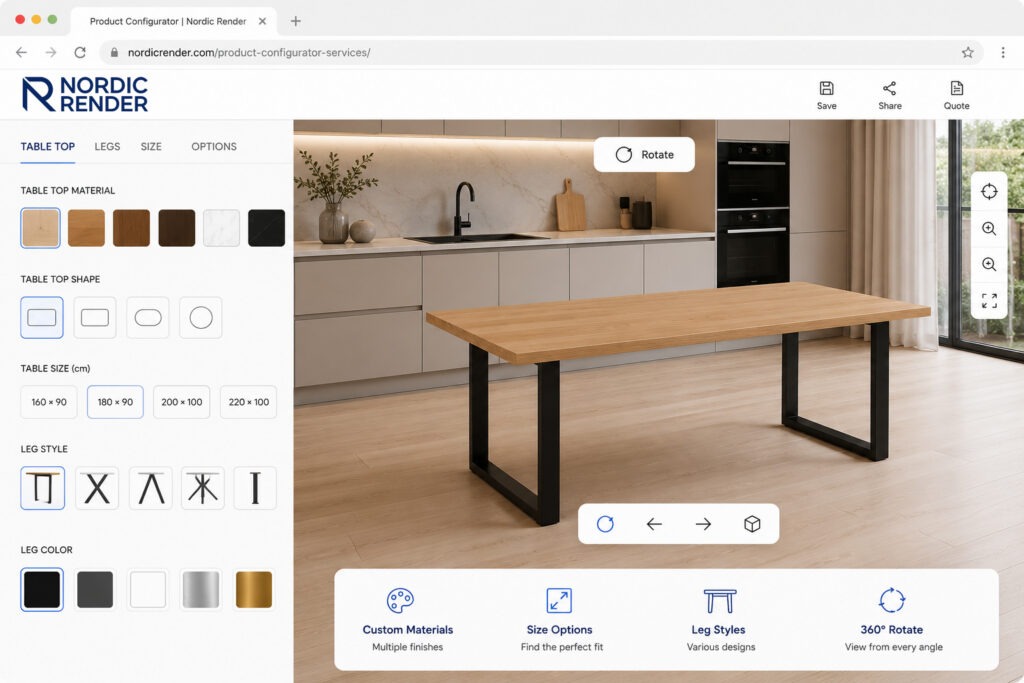
Every furniture manufacturer has unique products, production processes and customer journeys. For this reason, there is no universal configurator solution. At Nordic Render, we help manufacturers determine which type of interactive product experience best supports their products, customers and business goals. Depending on the project, this may range from a photography-based material visualizer to a fully interactive GLB configurator capable of presenting complex modular furniture systems directly in the browser.
We help manufacturers with:
- Furniture product configurators
- Product visualizers and planners
- Material and finish visualizers
- Interactive GLB configurators
- Photorealistic furniture CGI
- 3D modelling and optimisation for web applications
- Product animations for marketing and technical communication
- Interactive showroom experiences
Beyond implementation, we also advise manufacturers on selecting the most suitable approach. In some cases, a simple material visualizer provides everything required. In others, an interactive configurator offers greater flexibility and long-term value. The objective is always the same: helping manufacturers communicate increasingly complex products more clearly while supporting sales, marketing and customer understanding.
Because Nordic Render also creates the underlying 3D models, product CGI and animations, manufacturers benefit from a single partner throughout the entire process—from preparing visual assets to delivering a complete interactive product experience.
Conclusion
Furniture manufacturers are offering customers more choice than ever before through configurable collections, modular systems and extensive material libraries. While this flexibility creates significant value, it also makes products more challenging to communicate.
Interactive product configurators help bridge this gap by transforming complex product information into intuitive digital experiences. Rather than replacing traditional photography, catalogues or physical showrooms, they complement them by helping customers explore products more confidently and understand configurable options before speaking with a dealer or making a purchase. As digital product communication continues to evolve, configurators are becoming an increasingly valuable part of how furniture manufacturers present their collections, support dealer networks and strengthen customer experiences.
At Nordic Render, we work with manufacturers across multiple industries to develop interactive product experiences that make increasingly complex products easier to understand. This article reflects many of the questions we encounter when discussing configurators with furniture manufacturers exploring digital product communication for the first time.
Whether implemented as a simple material visualizer or a fully interactive GLB-based solution, the most successful configurators are those that help customers understand products with confidence while supporting long-term business goals.
Frequently Asked Questions
What is a furniture product configurator?
A furniture product configurator is an interactive application that allows customers to configure furniture by selecting options such as materials, colours, dimensions, modules or accessories while immediately visualising the result. Depending on the implementation, configurators may also generate quotations, product specifications or dealer enquiries.
Which furniture products are best suited for configurators?
Configurators are particularly valuable for modular sofas, kitchens, wardrobes, storage systems, office furniture, tables, shelving systems, outdoor furniture and other products with multiple configurable options. Even simpler product ranges can benefit from interactive material or finish visualizers.
What is the difference between a furniture configurator and a product visualizer?
A product visualizer primarily allows customers to explore colours, materials or finishes. A product configurator goes further by enabling users to configure different product variants, modules, dimensions or accessories according to predefined product rules. Many modern solutions combine both capabilities.
Should we choose a photography-based or a GLB-based configurator?
The answer depends on the product and the desired customer experience. Photography-based configurators are ideal for products with a limited number of variations and a strong emphasis on photorealism. GLB-based configurators are better suited to modular furniture and complex product ranges that benefit from interactive exploration.
Can a furniture configurator be integrated into our existing website?
Yes. Modern configurators can usually be integrated into existing websites and digital sales platforms. Depending on the project, they can also connect with product databases, quotation systems, ERP or PIM solutions.
Can Nordic Render create the 3D models as well?
Yes. Nordic Render provides the complete workflow—from 3D modelling and photorealistic product CGI to interactive configurator development and web integration. Existing CAD models, technical drawings or product photography can often be used as the starting point.
Can existing product data be used?
In many cases, yes. Existing CAD models, technical drawings, material libraries and product data can often be adapted for interactive configurators. The available source material determines how much preparation and optimisation is required.
How long does it take to develop a furniture configurator?
The timeline depends on the complexity of the product range, the number of configurable options, the level of visual detail and any required integrations. A simple material visualizer can often be completed much faster than a fully interactive configurator for a modular furniture system.
Is a furniture configurator suitable only for large manufacturers?
No. Many manufacturers begin with a single product family and expand their interactive product experience over time. Configurators can create value for companies of all sizes by making products easier to understand and supporting more effective digital communication.
References
Bambauer-Sachse, S. Do consumers prefer lower or higher numbers of customizable product attributes in an e-commerce context?. Electron Commer Res (2025). https://doi.org/10.1007/s10660-025-10014-2
CSIL. (2025). The European market for upholstered furniture. World Furniture Online. https://www.worldfurnitureonline.com/report/upholstered-furniture-market-europe/
European Furniture Industries Confederation. (2024). Annual report 2024. https://www.efic.eu/_files/ugd/a1d93b_957faceef29947129dd77a4aae95039b.pdf
Home Furnishings Association. (2025). The changing face of furniture retail & consumer behavior. https://myhfa.org/blog/the-changing-face-of-furniture-retail-consumer-behavior/
NielsenIQ. (2024). E-commerce trends in the furniture market for Q1 2024. https://nielseniq.com/global/en/insights/analysis/2024/ecommerce-trends-in-the-furniture-market-for-q1-2024/