
A Practical Guide for Manufacturers
Published on 21. Jul 2026

Kert Klementi
CEO & Founder | Business Visualization Strategist
Introduction
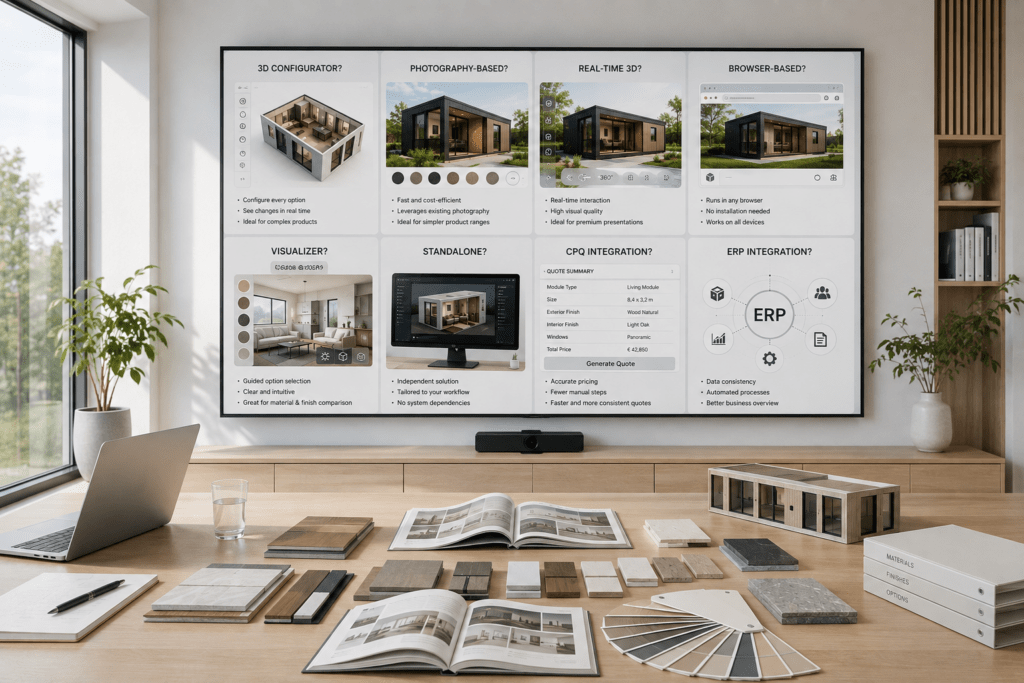
Choosing a product configurator has never been easier—and never been more confusing. Manufacturers exploring digital product experiences are presented with an increasing number of options. Product visualizers, 3D configurators, room planners, quotation tools, browser-based applications and fully integrated business platforms are often presented as competing solutions. In reality, each addresses different business needs, products and customer journeys.
At the same time, products themselves are becoming more configurable. Manufacturers increasingly offer multiple dimensions, materials, finishes, components and optional features, allowing customers to tailor products to their specific requirements. While this flexibility creates clear competitive advantages, it also makes products more difficult to communicate. Customers are expected to understand combinations that may never have existed physically before, often relying solely on digital information during the early stages of their purchasing journey.
As a result, the question is no longer whether manufacturers should improve digital product communication. The real question is how.
Many companies begin by comparing software platforms or technical features. They ask whether they need real-time 3D, augmented reality, ERP integration or AI-powered recommendations. These are important considerations, but they are rarely the best place to start.
The most successful configurator projects begin much earlier by asking a simpler question:
What business problem are we trying to solve?
If you are new to product configurators or would first like to understand how interactive product experiences work, explore our comprehensive guide Product Configurators. It examines the principles behind modern product configuration, the research supporting interactive product experiences and how manufacturers use configurators to improve digital product communication across different industries.
This guide builds on those foundations by focusing on the next question:
How do you choose the right product configurator for your business?
Rather than comparing software vendors or technical specifications, it takes a practical, business-focused approach to help manufacturers identify the type of interactive product experience that best supports their products, customers and sales process.
Digital Buying Behaviour Is Changing
The growing demand for product configurators is not driven by technology alone. It reflects a broader shift in how customers research products and make purchasing decisions. Across both B2B and B2C markets, buyers increasingly expect to complete much of their research independently before speaking with a salesperson. Company websites, online documentation and digital product experiences have become central sources of information, particularly during the early stages of the buying journey.
Gartner’s research into B2B buying behaviour highlights this change. Buyers increasingly prefer digital self-service when researching products and evaluating potential suppliers, while still expecting expert guidance once they move towards final selection and purchasing decisions (LaFond & Nguyen, 2024). For manufacturers, this means that product information must do more than simply describe a product. It must help customers understand increasingly complex solutions before direct contact with the sales team.
The same pattern is evident in digital commerce research. Baymard Institute’s latest Product Finding research, based on more than 5,500 hours of usability testing and 219 large-scale usability studies, found that customers frequently struggle to compare products and evaluate available options as online product ranges become more extensive and complex (Scott, 2024). Although the research focuses on ecommerce, the findings are equally relevant for manufacturers presenting configurable products. When available options are difficult to compare or understand, customers become less confident in their decisions and increasingly rely on additional guidance before moving forward in the purchasing process.
For manufacturers, this changes the role of the website. Rather than acting purely as a digital catalogue, it increasingly becomes the first stage of the sales process, where customers develop their initial understanding of configurable products and begin evaluating possible solutions.
Product Complexity Continues to Grow
Customer expectations are changing at the same time as products themselves become more sophisticated.
Manufacturers today rarely compete by offering a single standard product. Instead, they differentiate themselves through configurable product families, modular systems, material choices, optional features and customer-specific adaptations. This trend creates greater flexibility for customers while allowing companies to address a wider range of applications and market segments.
However, more options do not automatically create a better buying experience. Recent research into product variety complexity demonstrates that complexity is not determined simply by the number of available product variants. The relationships between options—such as compatibility rules, dependencies and technical constraints—often contribute far more to the difficulty of configuring a product than the number of visible choices alone (Modrak & Soltysova, 2023).
This distinction has important practical implications. A dining chair may be available in hundreds of material and colour combinations, yet the configuration process remains relatively straightforward because most choices are independent.
By contrast, an industrial ventilation unit or modular building may offer fewer visible options, but selecting one component may automatically influence dimensions, structural requirements, compatible accessories or manufacturing specifications. Despite having fewer customer choices, the underlying configuration process is significantly more complex.
Recognising this difference is one of the most important steps before selecting a configurator. The objective is not simply to count product variants, but to understand how they relate to one another and how much guidance customers require during the decision-making process.
Start with the Business Problem, Not the Technology
One of the most common mistakes manufacturers make is beginning the project by evaluating software.
Should we build a 3D configurator?
Do we need ERP integration?
Should we use GLB?
Can AI recommend products?
These are valid questions, but they are rarely the questions that determine whether a project succeeds.
A much more valuable starting point is identifying the underlying business challenge.
Perhaps customers struggle to compare materials and finishes online. Perhaps sales teams repeatedly answer the same product questions or spend considerable time preparing quotations for similar configurations. In other cases, dealers may need a more effective way to communicate configurable products without relying on extensive printed catalogues or physical samples.
Although these situations all involve product configuration, they require different solutions. Some manufacturers may achieve their objectives with a simple visual product explorer that allows customers to compare finishes and materials. Others may require guided configuration, quotation generation or integration with existing business systems. Defining the communication challenge before selecting the technology often leads to a simpler, more effective and more scalable solution.
Who Will Use the Configurator?
Before discussing features or integrations, manufacturers should consider who the configurator is intended to support. Surprisingly often, the answer is not simply “our customers.”
A well-designed configurator frequently serves multiple user groups throughout the customer journey. An architect may use it to evaluate products during the specification phase, a dealer to prepare a quotation, an internal sales representative to discuss project requirements with a customer, and the end customer to explore available options before making contact.
Each of these users has different objectives and requires different information. An end customer typically values simplicity, visual clarity and confidence that the selected product matches their needs. Architects and planners often require technical dimensions, downloadable specifications and BIM or CAD resources. Dealers may need pricing, configuration summaries or quotation support, while internal sales teams benefit from structured product information that reduces manual work during the sales process.
Recognising these differences early has a significant impact on the final solution. Some manufacturers ultimately provide different interfaces for different audiences while relying on the same underlying product data and configuration logic. Others intentionally keep the experience simple and focus on the audience that creates the greatest business value.
How Much Interaction Do Your Customers Actually Need?
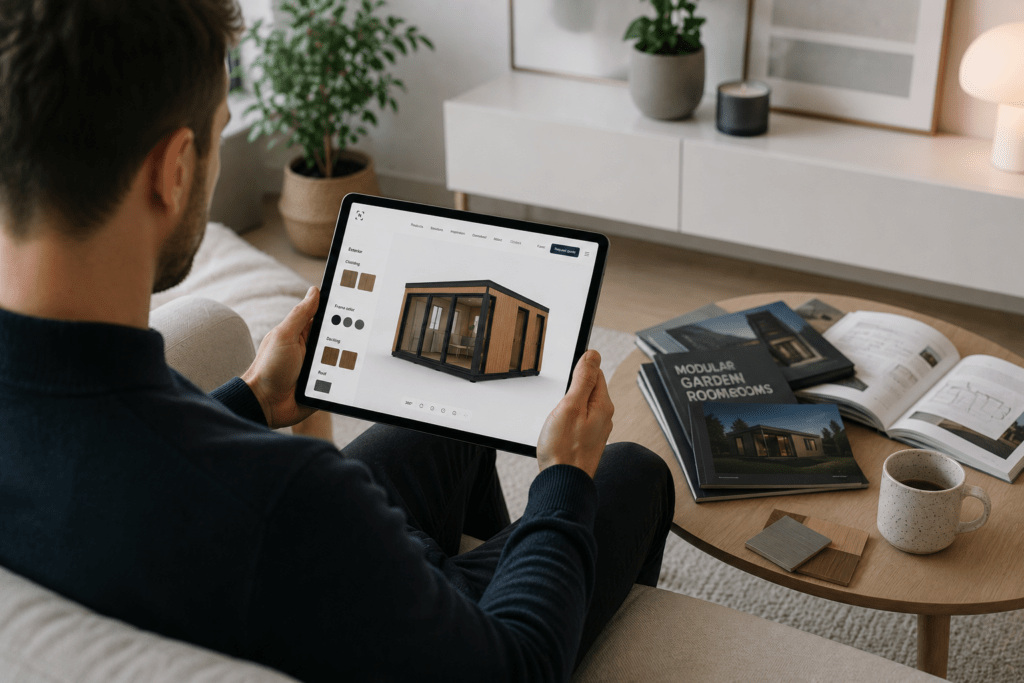
One of the most common assumptions is that a successful configurator must include every possible feature. In reality, the opposite is often true. The best interactive product experiences are not necessarily the most complex. They provide exactly the level of interaction customers need to evaluate products effectively — nothing more and nothing less.
For some products, allowing customers to compare colours, materials or finishes may be sufficient. A furniture manufacturer presenting upholstery options or a window manufacturer demonstrating frame colours may create significant value without introducing complex configuration logic.
Other products require considerably more guidance. Modular storage systems, industrial equipment or configurable building products often involve dependencies between components, dimensions or accessories. In these situations, customers benefit from a configurator that actively guides them through valid combinations instead of simply presenting every available option.
The appropriate level of interaction therefore depends on the product itself rather than the technology available. Before selecting a solution, manufacturers should consider questions such as:
- Do customers simply need to visualise different options?
- Should the configurator guide users through product selection?
- Are invalid combinations possible?
- Is technical expertise required to configure the product correctly?
- Should the final configuration support quotation or ordering?
Answering these questions provides a much stronger basis for selecting the right solution than comparing software feature lists.
Choosing the Right Visual Approach
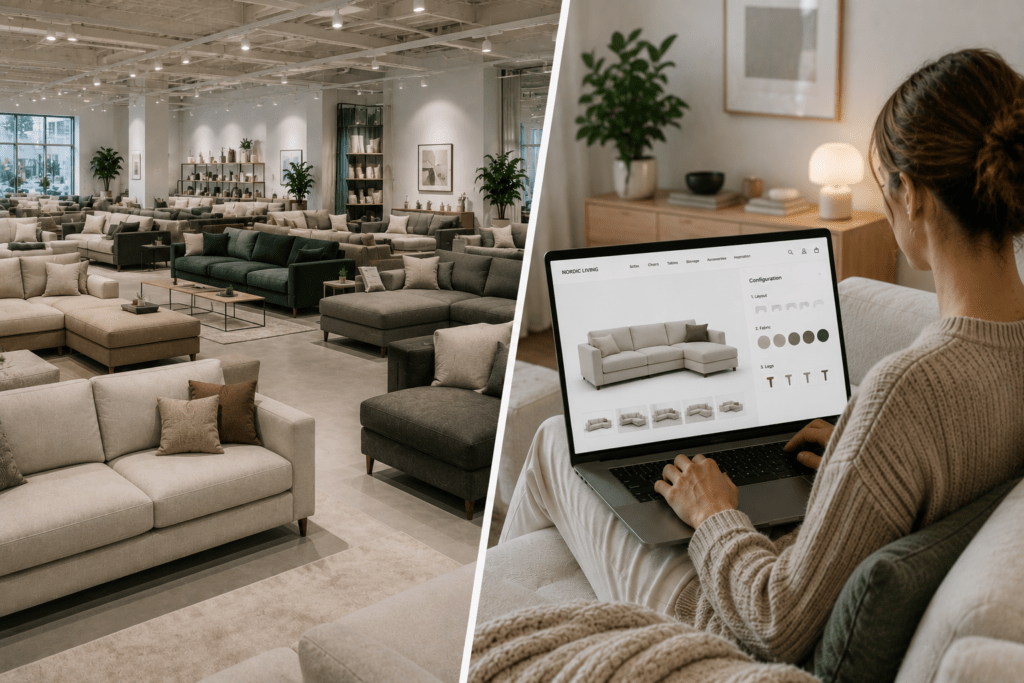
Not every configurator needs to look—or work—in the same way. Depending on the product, manufacturers generally choose between photography-based, interactive 3D or hybrid approaches. The right choice depends not only on the product itself, but also on how customers evaluate it, how configurable the product is, and which decisions they need to make during the buying process.
Photography-based solutions remain highly effective for many products, particularly when customers primarily compare colours, materials or finishes from predefined viewpoints. Existing product photography can often be reused, development is relatively straightforward, and the visual quality remains exceptionally high. For products with relatively simple variations, image-based configurators provide all the functionality customers require while keeping implementation efficient.
Interactive 3D becomes increasingly valuable when customers need to examine products from different angles, understand spatial relationships or configure modular product systems. Rather than maintaining hundreds or even thousands of individual product images, manufacturers can use a single parametric 3D model that responds instantly to customer selections. Rule-based configuration logic ensures that only valid combinations are presented, while new product variants can often be introduced without recreating extensive image libraries.
Many modern browser-based configurators use technologies such as WebGL and web-optimised GLB models to deliver real-time rendering directly within the browser. This enables smooth interaction without requiring customers to install additional software, while making it easier to integrate configurable products into websites, dealer portals and digital sales tools.
Many manufacturers ultimately combine both approaches. High-quality photography continues to play an important role in marketing campaigns, catalogues and brand communication, while interactive 3D supports product exploration, comparison and configuration during the evaluation process. Hybrid solutions often provide the best balance between visual quality, flexibility and long-term scalability.
If you would like to learn more about the technology behind modern browser-based configurators and how GLB supports interactive product experiences, explore our guide GLB Configurator for Manufacturers.
Ultimately, the decision is rarely about replacing one technology with another. It is about selecting the visual approach that best supports the product, the customer’s decision-making process and the manufacturer’s long-term business objectives.
Should Your Configurator Connect with Other Business Systems?
As manufacturers begin planning more advanced configurators, integration often becomes part of the conversation. Connecting a configurator with business systems such as Product Information Management (PIM), Customer Relationship Management (CRM), Enterprise Resource Planning (ERP) or Configure, Price, Quote (CPQ) solutions can streamline internal processes and reduce repetitive manual work. Configuration data entered once can support multiple business functions, from sales proposals and technical documentation to production planning and order processing.
For some manufacturers, quotation generation is one of the strongest drivers for implementing a configurator. Rather than preparing quotations manually, CPQ (Configure, Price, Quote) systems automatically apply product rules, pricing logic and configuration data to generate quotations, bills of materials (BOM), technical specifications and other sales documents. In many cases, interactive product configurators and CPQ solutions work together, allowing customers or sales teams to move seamlessly from product selection to an accurate quotation.
However, integration is not a prerequisite for every project. Research comparing separate and integrated configurator architectures concludes that there is no universal solution. The appropriate level of integration depends on operational requirements, organisational processes and how configuration data will be used after customers complete their selections (Zhang & Shafiee, 2022).
For many manufacturers, a standalone configurator focused on improving product communication delivers substantial value without requiring complex system integration. Others benefit from connecting configuration directly with pricing, quotations, manufacturing workflows or product data management as their digital capabilities mature.
The important decision is not whether integration is technically possible, but whether it supports the company’s long-term business goals.
Think Beyond the First Launch
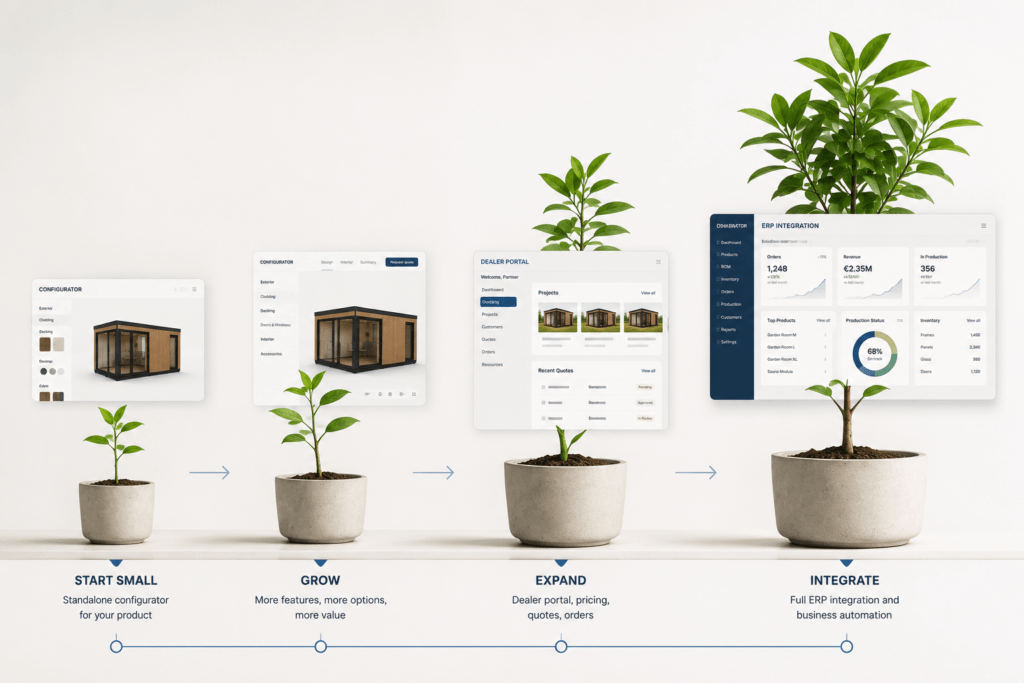
A configurator should not be viewed as a one-off project. Like a product portfolio, it evolves over time. Many successful manufacturers begin with a limited scope—a single product family, a material selector or an interactive product visualizer—and expand the solution as they gain experience and customer feedback. Additional products, configuration options, dealer functionality and system integrations can then be introduced gradually, reducing implementation risk while ensuring that future development reflects real real customer and operational needs.
This incremental approach also allows organisations to build internal knowledge. Teams learn how customers interact with the configurator, which features create the greatest value and where additional functionality genuinely improves the customer experience.
The objective is not to launch the most sophisticated configurator on day one. It is to create a solution that can grow alongside the business.
How Nordic Render Helps Manufacturers Choose
Selecting the right configurator is rarely about choosing software first. In our experience, the most successful projects begin by understanding the product, the people who will use it and the business objectives it should support.
Rather than recommending a particular platform or technology from the outset, we help manufacturers determine what level of configuration experience is actually required. For some products, a visualizer that allows customers to compare materials, colours or finishes may be entirely sufficient. Others benefit from real-time 3D, guided configuration, rule-based product logic or deeper integration with quotation (CPQ), ERP or other business systems.
Our role is to help manufacturers design interactive product experiences that simplify complex decisions rather than expose unnecessary complexity. This includes evaluating how products are configured, how customers compare alternatives, which information genuinely supports the buying process and which internal processes could be simplified. The goal is to create an experience that reduces uncertainty without overwhelming them, while supporting the manufacturer’s long-term business objectives.
Whether developing high-quality 3D content, browser-based configurators or fully integrated interactive product experiences, our focus remains the same: helping manufacturers communicate complex products more clearly, support the sales process and build digital solutions that can evolve alongside the business.
Conclusion
Choosing a product configurator is ultimately a business decision rather than a technology decision. Every manufacturer faces a different combination of products, customers, sales processes and internal workflows. As a result, there is no universal solution. The most effective configurator is the one that addresses the right business challenge while supporting both the customer journey and the company’s long-term objectives.
Rather than beginning with software comparisons or feature checklists, manufacturers should start by answering three fundamental questions:
- What business problem are we trying to solve?
- Who should the configurator support?
- How much guidance do our customers actually need?
The answers provide a far stronger foundation for selecting the right configurator than any technology specification. By understanding these requirements first, manufacturers can make informed technology decisions that improve product communication, support sales and create a solution that can evolve alongside the business.
Frequently Asked Questions
Do all manufacturers need a product configurator?
No. Products with limited variation may benefit more from a product visualizer or other forms of digital product communication. The appropriate solution depends on the complexity of the product and the business objectives rather than current technology trends.
Should we choose a photography-based or a 3D configurator?
Neither approach is universally better. Photography-based configurators are well suited to products with limited variation, while interactive 3D becomes increasingly valuable for configurable or modular products that customers need to explore from multiple angles.
Can a configurator support dealers as well as customers?
Yes. A well-designed product configurator can support multiple user groups, including customers, architects, dealers, distributors and internal sales teams. Each group can be provided with different information, functionality and levels of access according to their needs.
Do we need ERP or CRM integration from the beginning?
Not necessarily. Many successful projects begin as standalone product communication tools before later integrating with business systems as requirements evolve.
Can Nordic Render help us determine which solution is right for our business?
Yes. Every project begins with understanding your products, customers and business objectives. Only then do we recommend the type of interactive product experience that best supports your long-term goals.
References
LaFond, R., & Nguyen, L. (2024, February 13). Optimize websites to support B2B buying journeys. Gartner. https://www.gartner.com/en/documents/5193163
Modrak, V., & Soltysova, Z. (2023). Assessment of product variety complexity. Entropy, 25(1), 119. https://doi.org/10.3390/e25010119
Scott, E. (2024, September 17). 2024 e-commerce product finding: Expanded and updated research findings. Baymard Institute. https://baymard.com/blog/product-finding-2024-launch
Zhang, L. L., & Shafiee, S. (2022). Developing separate or integrated configurators? A longitudinal case study. International Journal of Production Economics, 249, Article 108517. https://doi.org/10.1016/j.ijpe.2022.108517